

There are two common methods for surface treatment of monolithic zirconium oxide crowns: polishing and glazing. But how do these affect the stability and aging properties of monolithic zirconium oxide crowns (multilayer)? Do the form of application and composition of the glaze have a decisive influence? Or does manual polishing score points with its advantages? The materials science research team at the Polyclinic for Dental Prosthetics at the LMU Munich has addressed these questions.
Moritz Hoffmann, Munich
Monolithic zirconium oxide crowns: Aim of surface treatment
Many users see digital design and manufacturing processes as an opportunity to reduce work steps and save time. Furthermore, a high level of aesthetics combined with optimal mechanical properties is a key focus. A common way to meet these requirements is the fabrication of monolithic crowns or bridges made of zirconia (multilayer or multigenerational zirconia). While the fabrication process is digitally supported, surface finishing (glazing, polishing) is usually done manually.
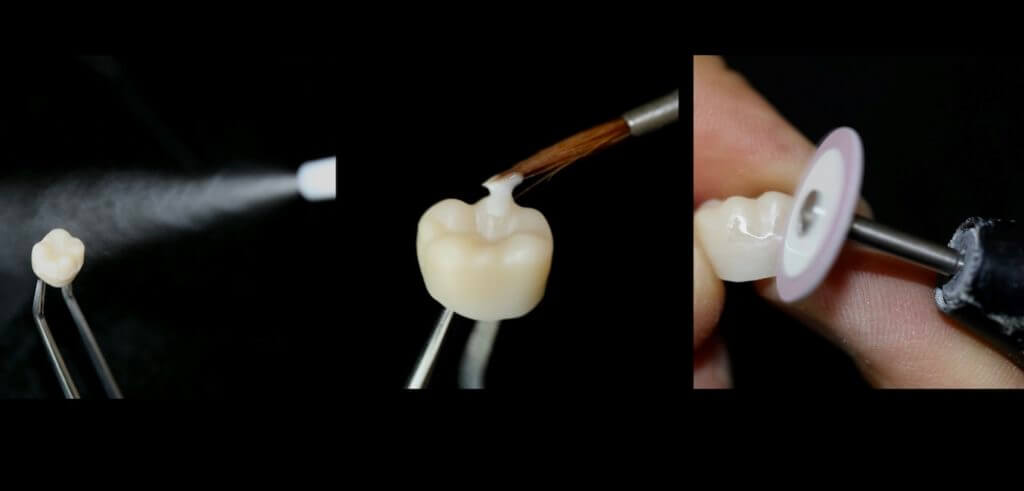
Common methods of surface finishing: glaze spray (left), glaze compound (middle), polish (right)
Basically, the surface treatment not only serves to improve aesthetics, but also reduces plaque adhesion on the restoration, promotes long-term stability and reduces the shaving processes on the (natural) antagonist. The surface is polished or glazing materials are applied. There are now time-saving approaches for the post-processing of monolithic zirconium oxide restorations, such as applying the glaze materials by spraying. The glazes can also differ in their composition. In an LMU study, possible differences between the various surface treatment methods were examined in more detail.
Aim of the investigation
The aim of the study was to examine the two common methods for surface finishing (glazing, polishing) of monolithic zirconium oxide restorations and their influence
- on the stability of the restorations and
- for possible signs of aging
to investigate. In addition to the actual method, the form of application of the glaze masses and their composition were also considered. A control group of natural teeth served as a reference.
material and methods
For the study, a total of 96 molar crowns were milled from third and fourth generation multilayer zirconium oxide (Multilayer 3D pro, Aidite Technology, Qinhuangdao, China | Ceramill Motion II, AmannGirrbach, Austria). 24 natural extracted molars served as a control group. After milling, the crowns were sintered according to the manufacturer's instructions (LHT 02/16, Nabertherm, Lilienthal/Bremen, Germany).
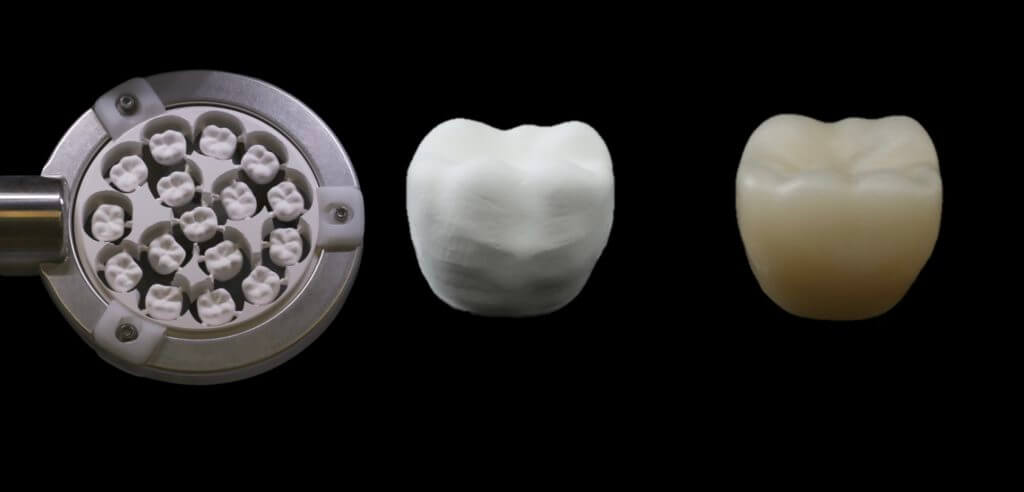
Production steps of molar crowns made from a multilayer zirconium oxide; Milling process (left), milled crown (middle), sintered crown (right)
Surface treatment
The crowns, divided into four groups, were cleaned after sintering and the surface was treated according to the manufacturer's instructions:
- Glaze spray n=24 (lithium silicate base, LiSiFuse Finish, HPdent, Gottmadingen, Germany)
- Glaze spray n=24 (leucite base, VITA AKZENT PLUS GLAZE SPRAY, VITA Zahnfabrik, Bad Säckingen, Germany)
- Glaze material n=24 (leucite base, VITA AKZENT PLUS GLAZE, VITA Zahnfabrik, Bad Säckingen, Germany)
- Polish n=24 (ceramic polisher (pink, Komet Dental, Lemgo, Germany), felt wheel with diamond polishing paste (DIA-GLACE, Yeti Dentalprodukte, Engen, Germany)
- Analogous to the production of the crowns, plates made of the zirconium oxide used were coated with the glaze materials, fired and the surface roughness (Ra, Rz) determined.
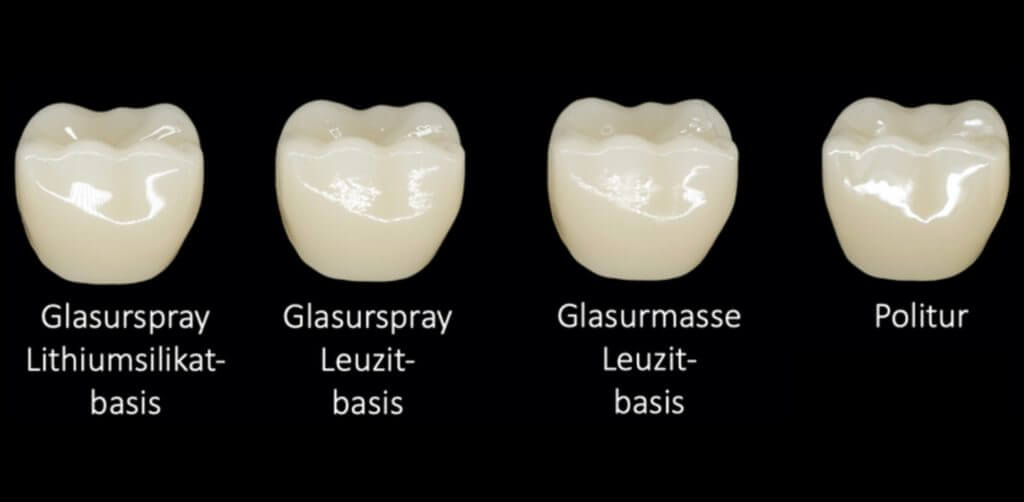
Comparative view of surface-treated zirconium oxide crowns
Storage, breaking load and aging process
The finished crowns were mounted on milled glass fiber reinforced synthetic resin dies (TRINA, Bicon Europe, Limerick, Ireland) with a dual-curing luting composite (SoloCem, Coltene/Whaledent, Altstätten, Switzerland) using an LED polymerization lamp (Elipar DeepCure-S, 3M Company , Saint Paul, USA) and stored in deionized water at 24°C for 37 hours.
The initial breaking load was determined on half of the crowns of all groups and the control group using a universal testing machine (Zwick RetroLine, ZwickRoell, Ulm, Germany). The occlusal surfaces of the other half of the crowns were scanned using a laser scanner (LAS-20, SD Mechatronik, Feldkrichen-Westerham, Germany). In the next step, all crowns were subjected to thermomechanical aging (1.200.000 chewing cycles, 50 N, 0,7 mm lateral movement, 1,3 Hz, 5°C/55°C) in the chewing simulator (CS-4, SD Mechatronics). Steatite spheres with a diameter of 6 mm, which were previously scanned, served as antagonists.
Examination
After the aging process, all crowns and the antagonists were scanned under the same conditions as before. The scan data sets could then be compared and conclusions drawn about possible aging-related abrasion effects on crowns and antagonists. This was followed by determining the breaking load of the crowns in the aged state, analogous to the initial test.
Results
surface roughness
The surface roughness values of the different glazes differ significantly (Ra) or show trends, depending on the characteristic value . The lithium silicate-based glaze spray exhibits the best surface properties, while the leucite-based glaze spray has the worst. The leucite-based glaze shows tendencies towards those of the leucite-based glaze spray.
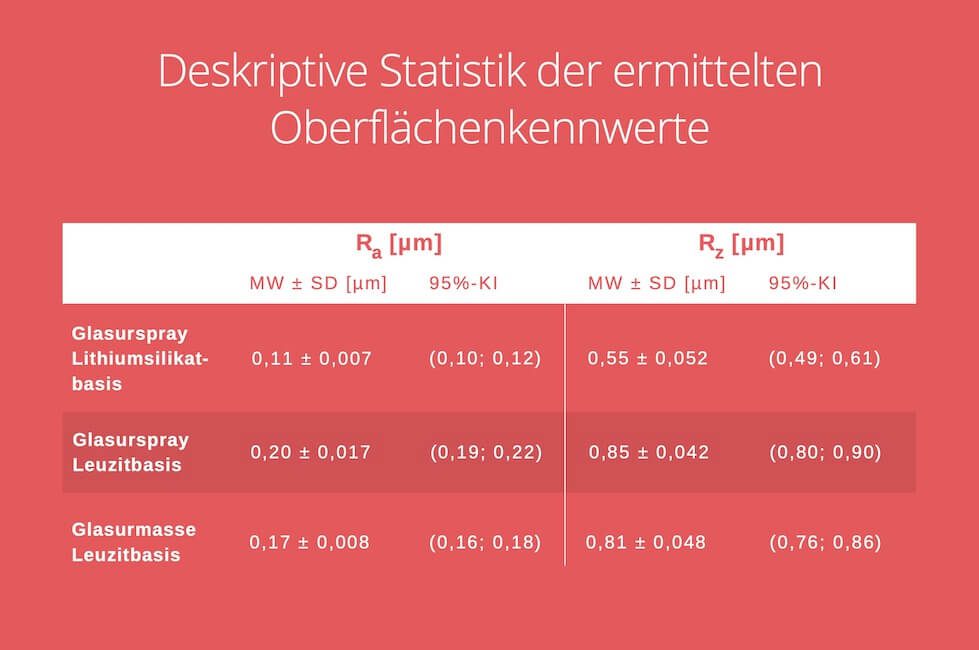
Descriptive statistics of the surface characteristics determined
breaking load
The determined breaking load values of all surface-treated zirconium oxide crowns both before and after aging show no significant differences. Natural teeth also show no aging effects in terms of breaking load. However, the breaking load values of natural teeth differ significantly from those of zirconium oxide crowns.
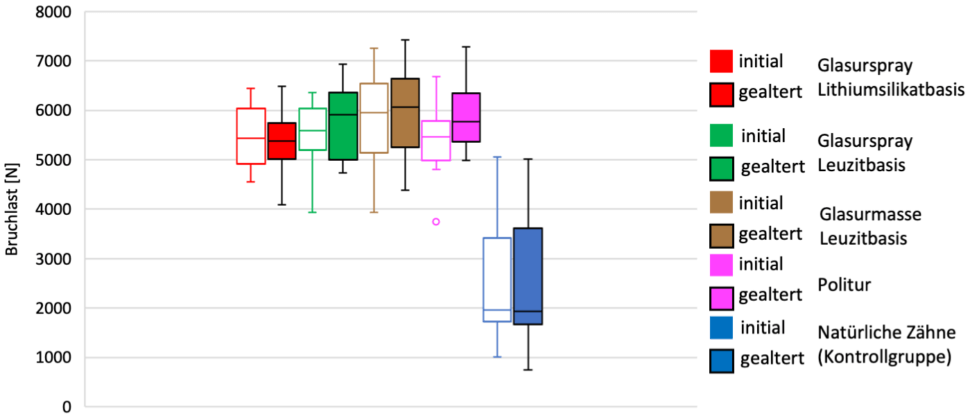
Graphical representation of the breaking load results as box plots
Weibull statistics
Both the Weibull modulus and the values of the characteristic strength of all surface-treated crowns are within a range of values before and after aging. However, significant differences in both parameters can only be found between all groups of surface-treated crowns compared to those in the control group with natural teeth in both aging stages.
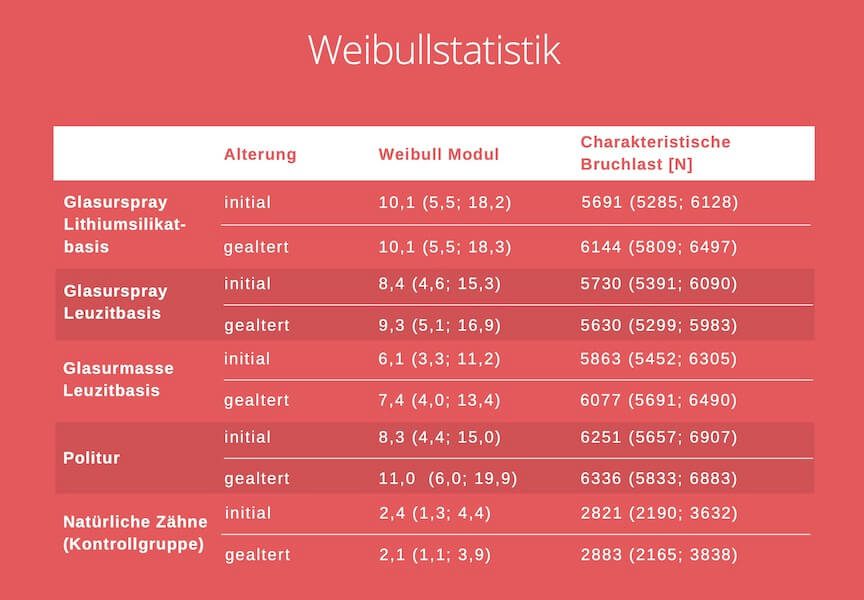
Weibull statistics
material removal
The statistical evaluation of the values of the determined material loss showed a significant correlation between abrasion height and abrasion volume - both on the crowns and on the antagonists. The chewing simulation resulted in comparable material removal for all glazed crowns. In the group with the polished zirconium oxide crowns, however, no material removal could be measured. The control group, on the other hand, showed the highest amount of substance loss, which in turn caused the lowest loss of material from the antagonist; followed by the lithium silicate-based glaze spray. The substance loss of the antagonists of all other tested groups lies within a range of values.
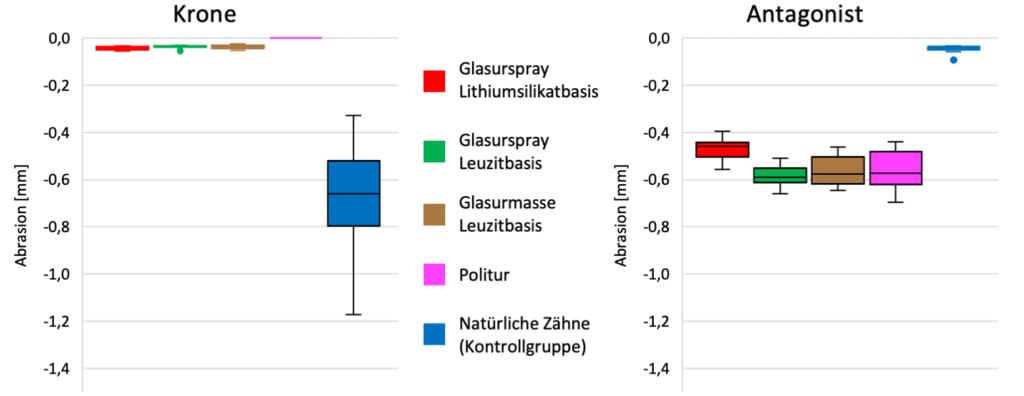
Graphical representation of the material removal (height) as box plots
Surface finishing of zirconium oxide crowns: conclusion
As a conclusion and practical tips for dealing with (surface-treated) monolithic zirconium oxide crowns, the following points can be noted:
- The stability of the surface-treated monolithic restorations examined is dependent on the material used zirconia (3rd and 4th generation). Surface treatment by applying a glaze mass is equivalent to polishing in terms of stability.
- Breaking load values are above the human chewing strength
- The stability of the surface-coated restorations is not affected by aging in the chewing simulator with 1.200.000 chewing cycles (accompanied by a thermal load change from 5°C to 55°C).
- The silicate ceramic glazes examined for surface finishing of monolithic zirconium oxide restorations did not prove to be abrasion-resistant. However, no material removal could be detected on the polished crowns. The lithium silicate-based glaze mass or a polish proved to be the gentlest method for surface finishing - with regard to abrasive processes on the steatite antagonists.
- When using glazing materials, polish the zirconium oxide surface in the contact area before applying the glazing material
- Regular checks for possible abrasion contacts by the dentist