
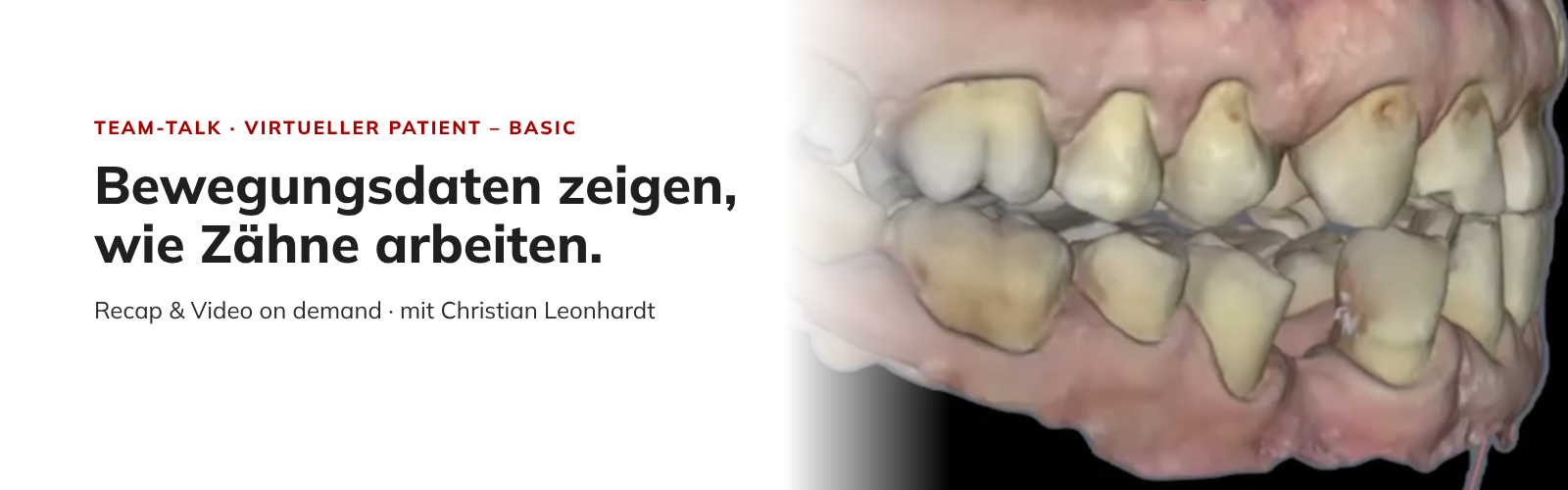
In dentistry, static datasets form the basis of many digital workflows. In the TEAM-Talk – BASIC “Virtual Patient,” Dr. Christian Leonhardt demonstrated what additional information dynamic patient data can provide and what implications this has for diagnostics, treatment planning, and collaboration between the practice and the laboratory. The recording is available here as video-on-demand.
The digital workflow in prosthetics is developing rapidly. Intraoral scans, facial scans, and virtual articulators are now commonplace. At the same time, it is becoming increasingly clear that a person is more than just a static data set. Movement, function, and individual dynamics play a crucial role in many prosthetic restorations.
The TEAM Talk – BASIC “Virtual Patient” with Christian Leonhardt addressed the central question: Are static datasets sufficient for reliably planning complex prosthetic rehabilitations? The answer that evening was nuanced: Yes and no. The recording of the TEAM Talk is available here.
- Static information remains an important foundation. In addition, real-world movements – such as opening and closing the mouth, chewing, speaking, or swallowing – can provide information that traditional datasets and articulator movements cannot capture. Jaw tracking makes precisely this dynamic visualization individually, thus opening up an additional dimension for diagnostics and treatment planning.
- Only the correct assignment of movement data to the digital dental models and their integration into a suitable CAD environment creates the prerequisite for taking patient-specific functional processes into account in the design of prosthetic restorations.
From static contact to movement space
Static occlusion shows where contacts exist. Dynamic data can additionally reveal when and along which movement path these contacts occur. Jaw tracking records real movements of the mandible and links them to digital models. This allows researchers to investigate, for example, the functional space required for chewing, speaking, or swallowing. This is particularly interesting in cases where recurring fractures or wear patterns cannot be conclusively explained by the static situation alone.
- Dynamic data complements the static occlusion with the actual movement pattern.
- What is crucial is not only where contact is established, but also when and through what means.
- Functional open spaces are relevant for the planning of reconstructions.
"Form follows function"
A central theme of the BASIC talk "Virtual Patient" was the question of how closely a planned tooth shape should be oriented towards individual function. Christian Leonhardt summarized this approach with "form follows function": The planned morphology should not be considered in isolation from the patient's actual range of motion. If this is not taken into account in a wax-up or reconstruction, interferences can arise that were not apparent in purely static planning. This shifts the perspective: The design is not solely determined by an idealized tooth shape or a predetermined guidance concept. Individual dynamics also set limits.
- Tooth shape and guidance should take into account the individual range of motion.
- A wax-up cannot only be assessed aesthetically and statically.
- Dynamic information can help identify potential interferences during the planning phase.
Envelope of Function: The function is the overarching principle.
Dr. Christian Leonhardt describes the concept of the Envelope of Function and addresses it as a central message.
"It is not the restoration that determines the movement – the movement determines the restoration."
Virtual patient: more than a single system
Jaw-tracking systems like ModJaw can capture movement data and combine it with other digital information. This includes intraoral scans, facial references, and—depending on the workflow—also CBCT datasets. The virtual patient is therefore not created by a single device. Rather, the crucial factor is the meaningful integration of diverse information and its interpretation in relation to the specific clinical question. Simply collecting data is not a diagnosis. Its value arises only when additional information actually helps to better assess risks or to verify treatment plans.
- The virtual patient is created by linking different data sets.
- A single device does not represent the entire patient.
- The clinical interpretation of the data is crucial.
Interface between practice and laboratory
Another question from the TEAM-Talk – BASIC: What happens to the collected data? Especially with dynamic datasets, the interface between dentistry and dental technology becomes crucial. Data acquisition, transfer, and use in design are three distinct steps. Only when movement information is incorporated into the planning can it be determined, for example, whether a digital wax-up extends into an individual's range of motion. For the practice and the laboratory, this means: The goal is not to collect as much data as possible, but rather to obtain the right information in a format that both sides can work with.
- Data collection, transmission, and use are three distinct steps.
- Movement data only becomes useful when it is incorporated into the design.
- Practice and laboratory need a common functional reference.
Analyze first, then plan
Perhaps the most pragmatic message of the evening was: Don't rush into a solution. Analysis precedes any reconstruction. What information is already available? What functional abnormalities are there? How can fractures or wear patterns be explained? And is there potentially missing data that would be relevant for risk assessment? In the TEAM Talk, this approach was described as risk management prior to actual treatment. Static occlusion remains part of the diagnostic process – but is supplemented by consideration of individual dynamics.
- Functional analysis precedes reconstruction.
- Recurring fractures and wear patterns should not be explained prematurely.
- Additional data is useful if it improves the risk assessment.
Summarized
The virtual patient doesn't simply mean "more digital". The real added value lies in making information visible that is missing in static datasets and using it in such a way that planning and functional reality better align.
For those who missed the TEAM-Talk – BASIC or would like to review individual topics: The recording is available here as video-on-demand.
Our TEAM Talks are intentionally freely accessible. This is made possible by the commitment of the members of EADT e.V. and the voluntary work of the board. Those who would like to support this work can find further information about membership here.