
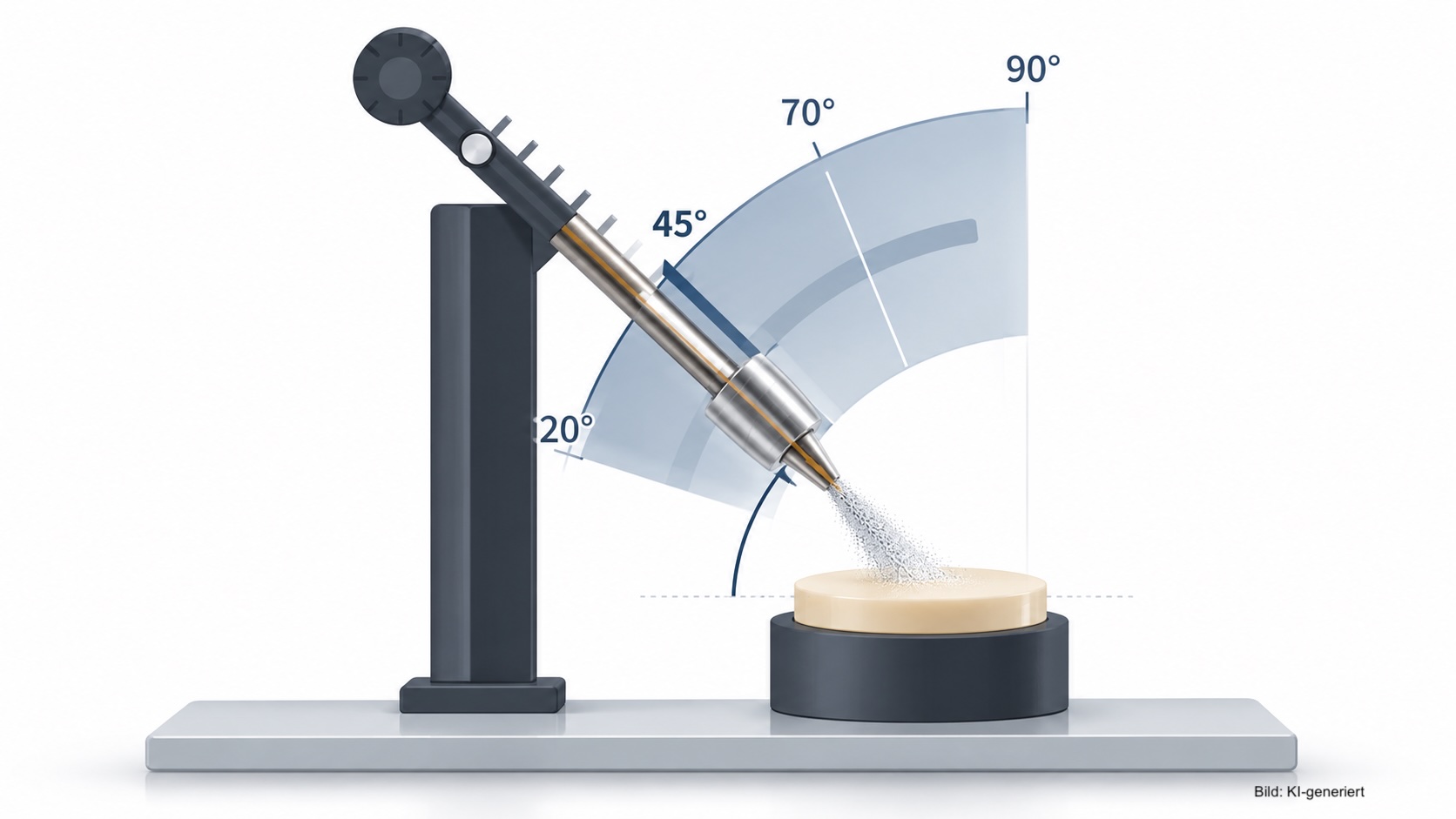
When blasting corundum, the focus is usually on the blasting media, particle size, and pressure. However, the blast angle could also play a role. A recent study investigates how different blast angles and nozzle geometries affect the surface properties and flexural strength of feldspar ceramics. The graphic schematically illustrates the blasting of feldspar ceramics at different blast angles between 20° and 90°.
Blasting with aluminum oxide particles (Al₂O₃ ) is a fundamental procedure in dentistry and dental technology. It is used for divesting cast objects and , above all , for conditioning restoration surfaces before adhesive bonding. The roughening process creates micromechanical retention, which is crucial for the long-term bonding of crowns, bridges, and veneers. However, under certain conditions, blasting can also damage the treated surface and thus reduce the reliability of the restoration.
The blasting media, particle size, and blasting pressure have been well studied. However, the impact angle (blast angle), nozzle geometry, and working distance have received considerably less attention. Feldspar ceramics with a high glassy phase content are typically etched with hydrofluoric acid before bonding; blasting is often avoided here due to the potential loss of strength.
From a clinical perspective, the beam angle is particularly relevant. With anatomically complex restorations – such as crowns, veneers, or multi-unit bridges – maintaining a constant angle across the entire surface is practically impossible. An angle of 45° is considered standard, while at 90° the kinetic energy is concentrated on a smaller area. Whether deviations from this angle alter the surface properties or impair the mechanical integrity of the feldspathic ceramic has not yet been investigated.
material and methods
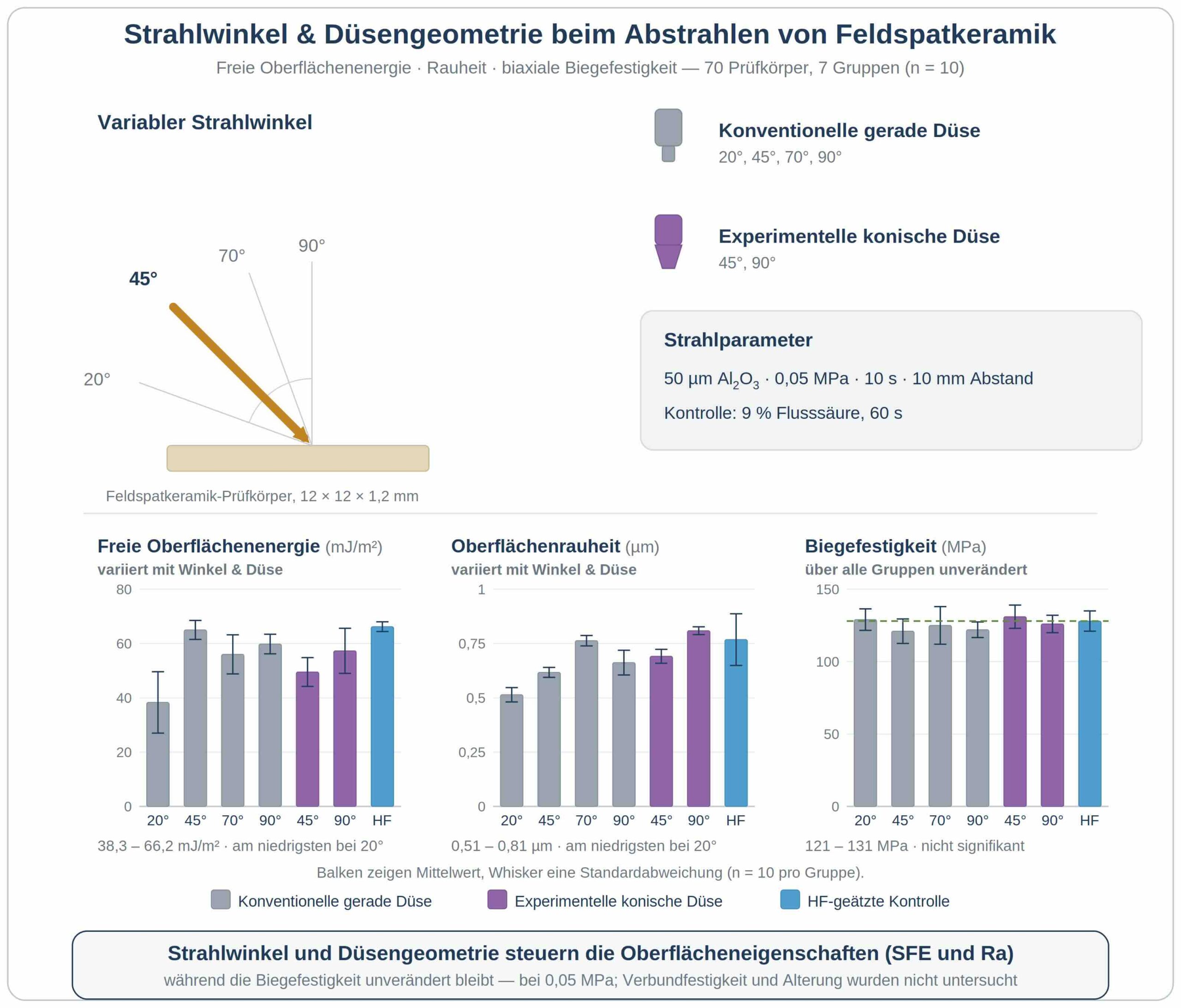
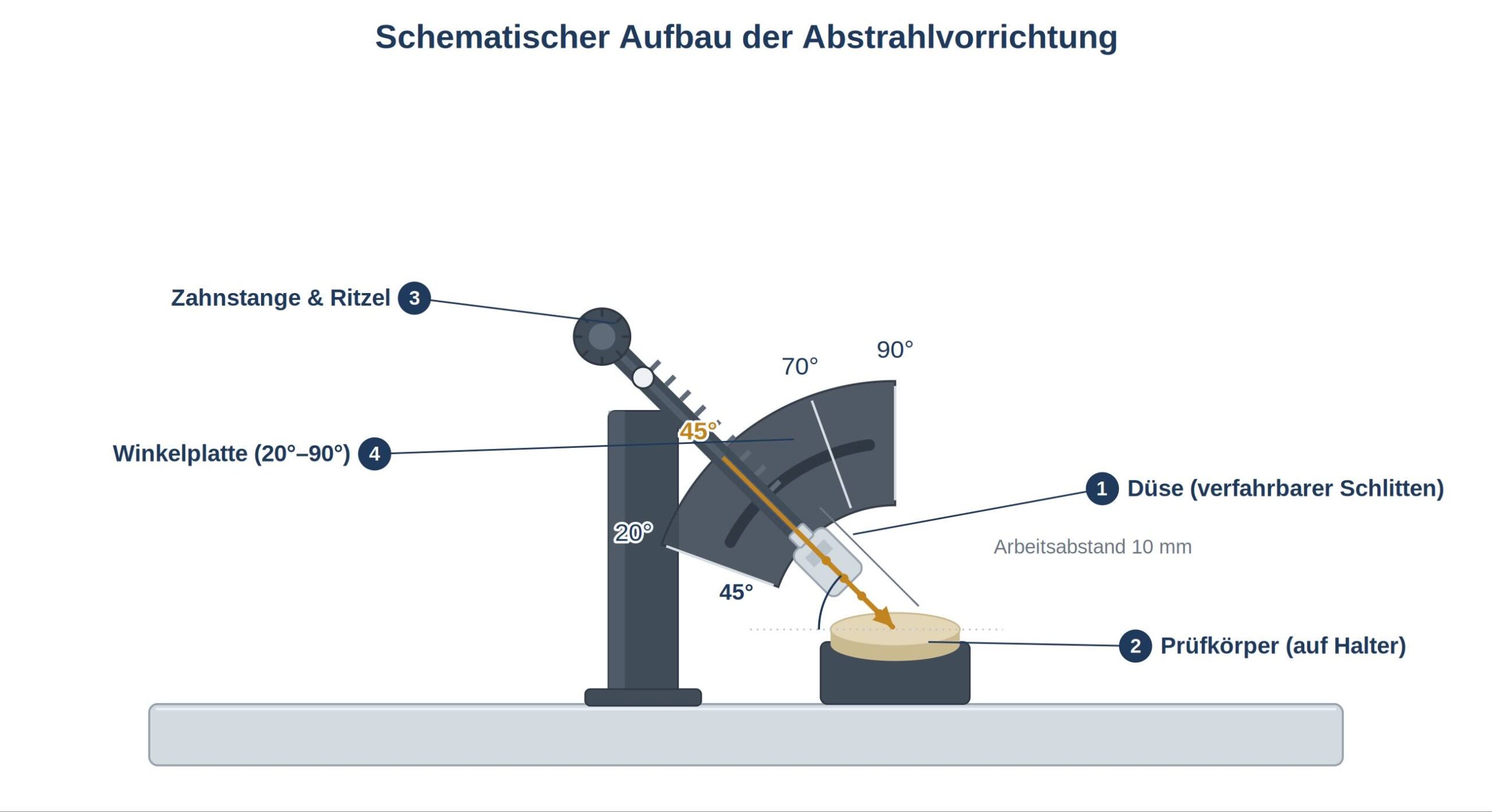
Seventy feldspathic ceramic specimens (12 × 12 × 1,2 mm) were fabricated from CAD/CAM blocks (VITABLOCS Mark II, VITA Zahnfabrik) and distributed into seven groups (n = 10) (Figure 1). Six groups were etched with 50 µm Al₂O₃ ( Cobra, Renfert) at 0,05 MPa for 10 s and a working distance of 10 mm – either with a conventional straight nozzle at 20°, 45°, 70°, or 90°, or with an experimental nozzle with a conical end section at 45° or 90°. The control group was etched with 9% hydrofluoric acid for 60 s. Both nozzles had the same channel inlet diameter (0,8 mm) and differed only in the geometry of the end section. The beam angle was set reproducibly using a specially manufactured positioning device (Figure 2).
The SFE was calculated from contact angle measurements and according to the Ström database. The Ra was determined tactilely (6 measuring sections per test specimen). The biaxial flexural strength was measured until fracture. Statistical evaluation was performed using one-way ANOVA and partial eta-squared (η p 2 ), Scheffé post-hoc test, and t-tests between the nozzles (p < 0,05).
Results
- Beam angle (ηp2 = 0,588) and nozzle type (ηp2 = 0,228) significantly influenced SFE and Ra (each p < 0,001).
- The shallow angle of 20° (conventional nozzle) yielded the lowest values for SFE (38,3 ± 11,3 mJ/m²) and Ra (0,514 ± 0,033 µm).
- At 45°, the conventional nozzle produced a higher SFE than the experimental nozzle.
- At 90°, the experimental nozzle produced a higher Ra than the conventional nozzle.
- With the conventional nozzle, an angle of 70° resulted in a higher Ra than 45° and 90°.
- The flexural strength ranged from 121 ± 8,5 to 131 ± 8,0 MPa and did not differ between the blasting groups or compared to the hydrofluoric acid etched control (p = 0,074).
The beam angle changes the surface, but not the flexural strength.
Under the investigated low-pressure conditions (0,05 MPa), the beam angle and nozzle geometry selectively altered the surface properties of the feldspar ceramic without measurably reducing the flexural strength. A shallow, more tangential particle impact angle apparently leads to less surface texturing, while steeper angles increase roughness and surface energy. Since maintaining a constant beam angle is practically impossible, these results may better reflect the variability encountered in practice than idealized laboratory protocols.
The null hypothesis was therefore only partially accepted: The surface parameters were significantly more sensitive to the beam angle than the mechanical integrity of the ceramic. Crucially, however, bond strength, aging behavior, failure modes, and clinical performance were not investigated. The observed differences between SFE and Ra should therefore not be interpreted as evidence of improved adhesion. Hydrofluoric acid etching (selective dissolution of the glass matrix) and sandblasting (mechanical surface modification) rely on different bonding mechanisms and are not readily interchangeable. Taken on their own, the results do not justify a recommendation to replace hydrofluoric acid etching with sandblasting. Furthermore, they apply exclusively to the tested protocol (0,05 MPa) and the ceramic examined; higher blasting pressures may lead to different results. Further investigations into different pressure levels, bond strength, and long-term behavior are necessary.
examination
The results presented here are based on the following study: Lankes V, Coldea A, Meinen J, Stawarczyk B. Influence of Varying Airborne-Particle Abrasion Angles on Surface Properties and Flexural Strength of Feldspar Ceramic. J Funct Biomater 2026;17:358. https://doi.org/10.3390/jfb17080358