

All-ceramic is now standard practice in dentistry. But which material offers better long-term stability? A recent study by the Universities of Bern, Munich, and Istanbul examined the fatigue behavior of five lithium disilicate ceramics compared to translucent 5Y-TZP zirconium oxide. The results provide important insights for daily material selection in practices and laboratories. (© Image: Master Dental Technician Stefan Roozen)
In all-ceramic restorations, the choice of material plays a crucial role in clinical success. The properties of the specific all-ceramic material used are of central importance. Lithium disilicate ceramics, in particular, have established themselves as a popular option due to their excellent aesthetic and mechanical properties. These ceramics are characterized by their high translucency and opalescence, making them ideal for aesthetic restorations, especially in the visible anterior region.
In contrast, zirconia is attributed with high mechanical stability. Zirconia ceramic 5Y-TZP is considered one of the most translucent zirconias, but has lower mechanical properties compared to other zirconia modifications and is therefore not approved for bridges in the posterior region.
A recent international study by the University of Bern, the LMU Munich and the Biruni University Istanbul compared the fatigue behavior of five pressed lithium disilicate ceramics with a 5Y-TZP zirconia ceramic to find out how these materials behave under dynamic loads.
The superficial micro-defects can have a negative impact on the overall stability and must therefore be avoided by choosing the right parameters (blasting media, blasting pressure, distance and angle).
The lithium disilicate ceramics tested included:
- Amber Press HT R10/A2, HASSBio, Kangneung, Korea
- Celtra Press HT 12, Dentsply Sirona, Hanau, Germany
- Initial LiSi Press LT-A2, GC Europe, Leuven, Belgium
- IPS e.max Press HT A2, Ivoclar AG, Schaan, Liechtenstein
- Livento Press MT A2, Cendres + Métaux, Biel, Switzerland
The control group was a 5Y-TZP zirconia ceramic, Ceramill Zolid fx ML A2/A3, AmannGirrbach, Mäder, Austria.
material and methods
The pressed all-ceramic test specimens were produced by milling wax test specimens from wax discs (Ceramill WAX, Amann Girrbach AG) using a five-axis milling unit (Ceramill Motion 2). Three wax test specimens were sprued for each muffle and then invested with the respective investment material from the manufacturer of the lithium disilicate ceramic. After the investment material had set, the muffles were preheated to 60 °C for 860 minutes and then pressed with the respective ceramic in a ceramic press furnace (Austromat 654 press-i-dent). After cooling to room temperature, the test specimens were removed from the investment material and completely sandblasted to remove the investment material. Nutshell granules were used for coarse blasting and glass beads for fine blasting.
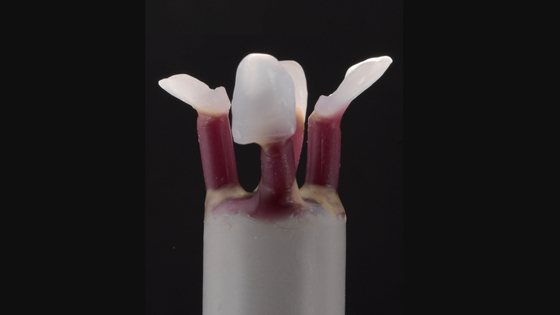


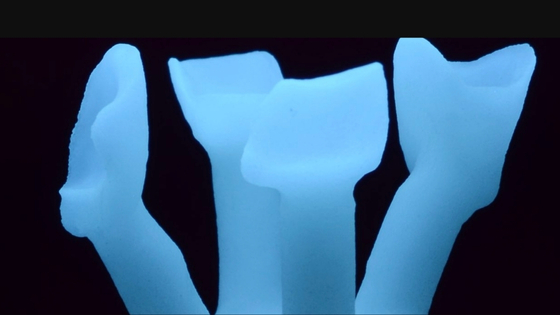

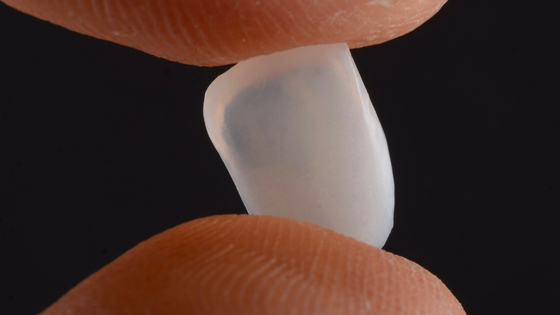
Pressing technique for fabricating veneers from lithium disilicate ceramic (spruing, pressing, and devesting, fluorescence imaging, finished veneers before insertion). Images: © Images: Master Dental Technician Stefan Roozen
The zirconia test specimens were milled and then sintered according to the manufacturer's specifications. The final dimensions of all test specimens after additional polishing were 30 mm in length, 4 mm ±0,2 mm in width, and 3 mm ±0,2 mm in thickness. These dimensions were checked three times with a digital micrometer. To test the fatigue behavior of the materials and determine the starting load, static fracture load tests were first performed. The static fracture load was determined using a four-point bending test. Six test specimens of each material were tested to determine the starting load; this was defined as 30% of their strength.
The remaining 48n test specimens of each material were then divided into three groups and subjected to dynamic loading. The loading protocols included:
- Protocol 1: Increase the starting load by 50 N every 5000 cycles.
- Protocol 2: Increase the starting load by 5% every 5000 cycles.
- Protocol 3: Increase the starting load by 10 N every 1000 cycles.
The same testing device was used for the dynamic tests, applying a frequency of 10 Hz until failure. The four-point bending strength was calculated. This methodical approach made it possible to evaluate the fatigue behavior of the various ceramics (all-ceramic) under realistic conditions and gain valuable insights into their performance in clinical use.
Results
The study results showed significant differences between the tested materials in terms of their stability and the number of loading cycles to failure. Zirconia ceramics exhibited the highest values, with an average static fracture load of 1223 N—a result consistent with previous studies. In comparison, the values for the lithium disilicate ceramics were as follows: Livento Press at 492 N, Initial LiSi Press at 573 N, Celtra Press at 617 N, Amber Press at 669 N, and IPS e.max at 677 N.
However, all tested materials achieved strength values of more than 100 MPa—this is considered the minimum value for adhesively bonded monolithic single-tooth restorations. Therefore, all materials tested in this study can be used safely for single-tooth restorations.
The analysis also showed that the second loading protocol was most beneficial for lithium disilicate ceramics, resulting in the highest number of cycles to failure (P ≤ 0.041). Considering all data, zirconia had the highest number of cycles to failure overall (P < 0.001), while IPS e.max Press and Amber Press also showed higher values than Celtra Press (P ≤ 0.010).
Fractographic analyses confirmed correct test conditions: cracks initiated on the tensile side; compression waves were clearly visible on the opposite side.
Importance for practice
All-ceramic: It is crucial for dental technicians and dentists to understand the different properties of available ceramics. Choosing the right all-ceramic can be crucial for the long-term success of a restoration—and thus also for patient satisfaction. This study demonstrates that pressed lithium disilicate ceramics are an excellent option—especially when considering their fatigue behavior under realistic conditions, such as fatigue tests.
However, it is important to emphasize that future research is needed to further investigate the fatigue behavior of lithium disilicate ceramics. In particular, studies comparing pressed and ground ceramics or applying different loading protocols are needed.
In summary, pressed lithium disilicate ceramics are not only aesthetically pleasing; they also offer sufficient mechanical stability for use as single-tooth restorations. By relying on such studies and incorporating their results into our material selection, we can ensure that patients receive the best possible care.
Furthermore, we must be aware that the processing, finishing, and cementation also play a crucial role in the overall stability of the restoration. It is essential not only to follow the manufacturer's instructions during restoration fabrication, but also to promote open communication and an active exchange of knowledge between the dental technician and dentist. Only in this way can we jointly achieve optimal results, minimize complaints, and strengthen our patients' trust.
examination
The results presented here are based on the following study: Buser R, Dönmez MB, Hoffmann M, Hampe R, Stawarczyk B. Fatigue behavior and reliability of pressed lithium disilicate ceramics compared to 5Y-TZP zirconia under different loading protocols. Dent Mater 2025;41(2):134-140