EADT eV – Status quo and dilemmas in dentistry and dental technology
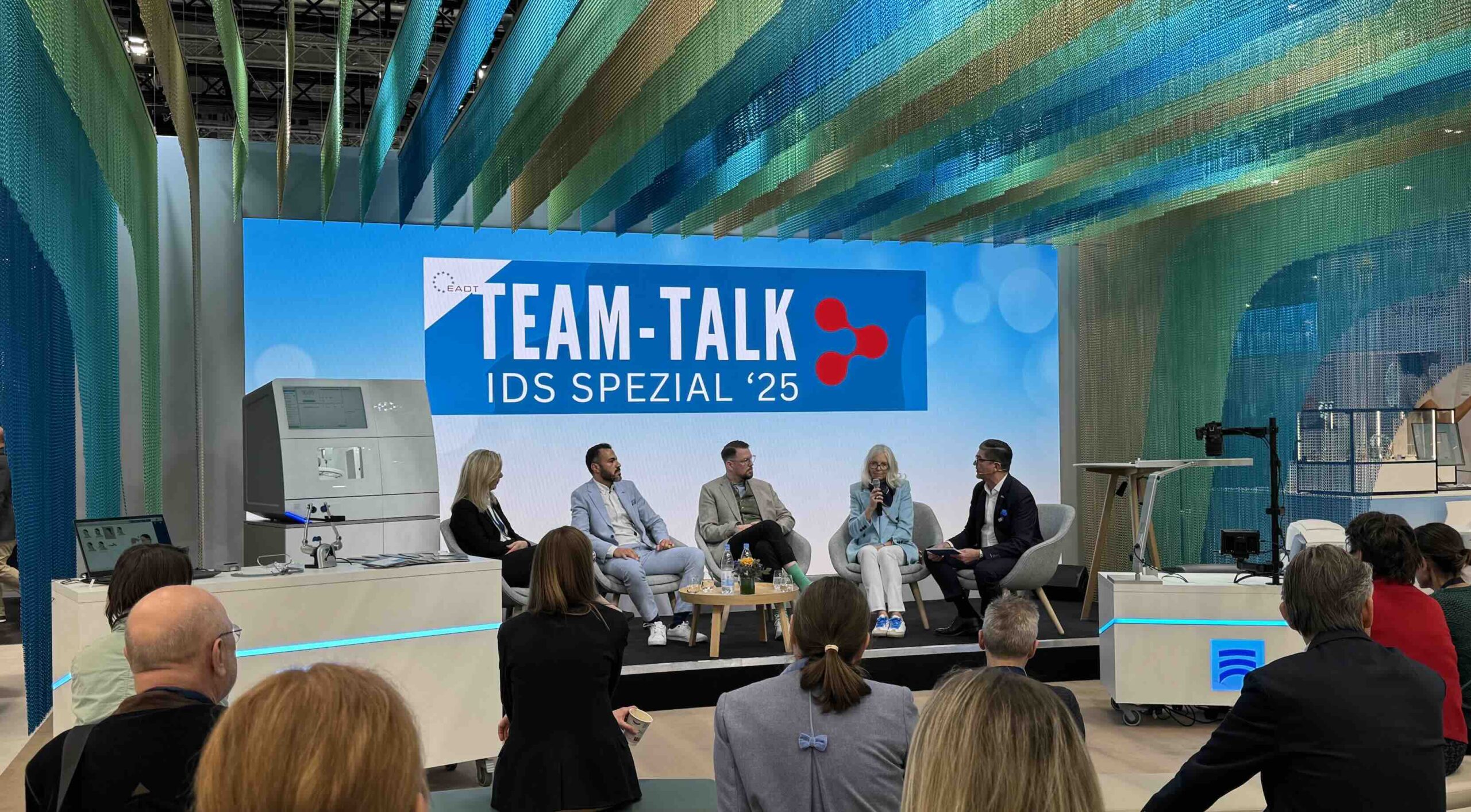
Freshly back from IDS 2025, EADT e.V. looks back on an inspiring week at the trade fair. While we're still overwhelmed by the wealth of impressions, we're primarily taking away positive experiences and a fantastic trade fair atmosphere. In our "IDS Special" TEAM Talk, four experts analyzed trends and developments from various perspectives. Dentistry, dental technology, materials science, and dental technology – our team of experts put their heads together and distilled the essence of the trade fair days.
The expert panel of the EADT eV
Dr. Gertrud Fabel (Dentistry), Martina Schmitz (Dental Technology), Dr. Adham Elsayed (Science/Dental Industry), and Sebastian Spintzyk MSc. (Science/Dental Technology) discussed current developments and took a differentiated look at the changes in digital dentistry and their impact on everyday practice and laboratory work.
Four key statements
1. The balance between digital efficiency and patient-centered treatment is crucial
A key topic was workflow optimization , particularly with regard to the single-visit dentistry approach. Gertrud Fabel spoke about chairside fabrication and emphasized the importance of all-ceramic materials. The goal here is to design treatment steps such as preparation, scanning, and insertion in such a way that the patient ideally doesn't have to leave the treatment room. The challenge lies in shortening process times . Faster milling times for ceramics, 3D-printed crowns with promising processing times of only 20 to 25 minutes, and materials that no longer require firing in post-processing all contribute to this increase in efficiency. However, the dentist stressed that simply reducing treatment minutes reaches its limits when administrative processes consume unnecessary time: "There are more and more programs, which complicates our workflows." Up to 20 different software programs in an average practice pose a serious problem. Therefore, it is essential to establish streamlined, holistic processes that benefit the patient without jeopardizing profitability.
2. Despite digital transformation, analogue knowledge remains indispensable
Digitalization in dental practices and dental laboratories is unstoppable and has supplemented or replaced many traditional treatment concepts. Martina Schmitz addressed the role of dental technology in the digital age, contributing a valuable perspective based on her 35 years of experience as a dental technician . While appreciating the advantages of digitalization, she is convinced that even the best digital technology is useless without analog knowledge. She also emphasized the three-dimensional understanding that can only be developed by working with a physical model. In ceramic veneering, her manual layering technique allows for individualization with characteristics that are more difficult to achieve digitally. Regarding costs , she noted that faster manufacturing processes could potentially be reflected in the price, but also pointed out that technological acquisitions are expensive , raising the question of how these costs can be passed on. This may indicate a divide between laboratories that work very simply and those that use expensive tools. Finally, she emphasized the necessity of a solid foundation . A perfect impression , whether analog or digital, remains essential for high-quality restorations.
3. The rapid development of materials and technologies
The speed at which new materials and technologies are entering the market is enormous. This also applies to adhesive cementation . Adham Elsayed focused on universal products and coordinated workflows. In the field of adhesive cementation, he presented the possibilities offered by zirconia and universal adhesives. A key point of his presentation was the trend toward single-bottle systems. Although universal adhesives promise simplification, not all of them perform equally well and their performance must be evaluated. Choosing the "right" innovations requires weighing features against actual patient benefits . Sebastian Spintzyk complemented this perspective with his insights into 3D printing . He reported on fully automated processes , from printing and cleaning to light curing, advances in powder bed metallurgy, hybrid manufacturing for removable dentures, and the expanded range of materials. An important topic was how standardization and validated protocols contribute to quality assurance .
4. The pace of innovation as a key challenge
Given the high investment costs for new technologies and the need to train staff, the question of economic feasibility arises . Furthermore, the problem was raised that users can hardly keep pace with the rapid innovation cycles . In the field of materials, there is hardly any time to familiarize oneself with a new technology and establish internal standards before the next innovation hits the market. This disruptiveness , familiar from the IT sector, forces users to make decisions. They cannot try out every new development, as ultimately, economic processes take precedence. One should choose a specific area and master it thoroughly, instead of blindly following the motto "higher, faster, further." The question is not always what will change in the next three years, but rather what one can rely on during that time. Ultimately, it is not hype, but practical benefit that determines the success of an innovation.
Conclusion of the EADT TEAM Talk
The key messages of the discussion highlighted the areas of tension in which dentistry and dental technology operate: the balance between efficiency and patient orientation, the interplay of digital and analogue skills, and the challenges posed by rapid material and technological development.
The EADT TEAM Talk at IDS 2025 painted a vivid picture of the challenges and opportunities in dentistry. The integration of digital technologies is advancing, offering immense opportunities for increased efficiency and improved patient care. At the same time, this transformation requires a careful balance between innovation and tried-and-tested practices, continuous training, and user-friendly solutions that meet the needs of users and, above all, patients.
We at EADT e. V. would like to sincerely thank Amann Girrbach for the fantastic stage and technical support! The complete recording of the TEAM Talk “IDS Special 2025” is available here: