
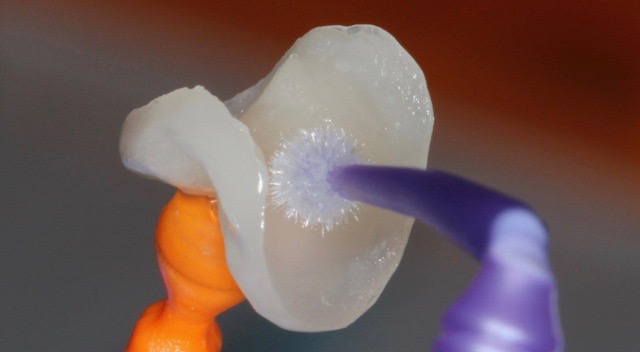
The adhesive bonding of all-ceramic restorations places high demands on the dentist and requires good consultation with the dental technician. Some basic aspects are briefly and succinctly presented here.
Authors: Anja Liebermann, Annett Kieschnick, Bogna Stawarczyk
1. Preparation form
If the tooth stumps (preparations) are too short (< 4mm) and prepared too conically, the ceramic restoration should be cemented adhesively for optimal bonding. If preparations are too conical, fixation with a self-adhesive luting composite cannot achieve an adequate, long-lasting bond.
2. Temporary restoration before adhesive fixation
When attaching the temporary restoration, it should be clear whether the final restoration will later be attached adhesively. If adhesive cementation is planned, only eugenol-free temporary cements should be used for the temporary restoration, e.g. B. RelyX Temp NE (3M) or Freegenol Temporary Pack (GC Europe). Reason: Eugenol-containing preparations can impair the polymerization of the necessary methacrylate-based adhesive systems.
3. Adhesive fixation in general
Restorations made of ceramic materials with a strength below 350 MPa (e.g., feldspathic/leucite ceramics) must be adhesively bonded. While restorations with higher strength can also be cemented, adhesive bonding offers greater overall stability. Zirconia bridges should always be adhesively bonded.
4. Cleaning of restorations after try-in in the patient's mouth
Before cementation, each restoration should be cleaned after try-in and contamination with saliva in the patient's mouth. There are different approaches in practice for the different materials. For example, metal-based or all-ceramic restorations can be easily cleaned with alcohol. The use of an ultrasonic bath is also suitable for this.
It is important that alcohol should only be used to a limited extent when cleaning plastic-based materials. Reason: The plastic surface is sometimes significantly affected and can also lose any shine and become milky due to contamination with alcohol.
When it comes to zirconium oxide restorations, it should be noted that they should under no circumstances come into contact with phosphoric acid (especially not cleaning them) if adhesive cementation is planned. Otherwise, the phosphorus molecules firmly occupy the binding sites that are necessary for chemical adhesion to the fastening material.
5. Drainage
Complete drainage is only possible using a rubber dam. However, relative drainage is possible with a Teflon tape, with threads (with or without retraction agents) in the sulcus and with cotton rolls. With conventional adhesive fixation, optimal drainage is crucial, whereas with self-adhesive fixation, a rubber dam is not absolutely necessary. In the case of self-adhesive attachment, the melting areas should also be etched with phosphoric acid in order to achieve a better adhesive bond.
6. Universal adhesive systems
Complete drainage is only possible using a rubber dam. However, relative drainage is possible with a Teflon tape, with threads (with or without retraction agents) in the sulcus and with cotton rolls. With conventional adhesive fixation, optimal drainage is crucial, whereas with self-adhesive fixation, a rubber dam is not absolutely necessary. In the case of self-adhesive attachment, the melting areas should also be etched with phosphoric acid in order to achieve a better adhesive bond.
7. Transparent aesthetic restorations
Glass ceramics and 3rd and 4th generation zirconium oxides have high levels of translucency. Cementation can have a negative impact on the aesthetic properties. It is therefore recommended that these restorations are cemented adhesively.
8. Surface pretreatment
It is recommended that the pretreatment of the restoration (e.g. etching, sandblasting) be carried out in the practice immediately before cementation. An inner surface of the restoration that has been pretreated in the laboratory can be negatively affected by the try-in and contamination with saliva.
Further information: Here