

Filament printing is increasingly gaining attention as an alternative additive manufacturing process for temporary restorations. However, how precise and durable are FFF-fabricated restorations made of PMMA and PET compared to DLP-printed and CAD/CAM-milled restorations? This article presents the results of a study on mechanical properties, accuracy, bond behavior, and retention.
Additive manufacturing processes are gaining increasing importance in restorative dentistry and complement established subtractive manufacturing methods such as computer-aided milling (CAD/CAM). While vat photopolymerization, for example using Digital Light Processing (DLP), has already become clinically established, fused filament fabrication (FFF) is increasingly becoming the focus of scientific research due to its economical production, low material consumption, and ease of processing.
In FFF (Fused Film Forming), thermoplastic materials are processed layer by layer. Despite its advantages, limitations remain regarding accuracy, surface quality, and process stability, which is why its application has so far been primarily restricted to the production of dental models. Only a few studies exist on its use in temporary restorations.
Provisional restorations must ensure function, esthetics, and phonation during the treatment phase while simultaneously exhibiting sufficient mechanical properties and high precision. Against this background, FFF-fabricated restorations made of PMMA and PET were investigated with regard to their mechanical properties, accuracy, and bond strength, and compared with DLP-printed and CAD/CAM-milled restorations. This paper presents selected results of this comprehensive investigation.
Filament printing is an additive manufacturing process that opens up new possibilities for the production of temporary restorations and must be evaluated in terms of precision, durability and bonding behavior.
Material and method
Initial breaking load measurement
To determine the initial fracture load, posterior crowns, occlusal veneers and anterior crowns were fabricated using Fused Filament Fabrication (FFF; SIMPLEX 2 SX, Renfert GmbH, Hilzingen, Germany) from PMMA (The.r.mo.bridge, Pressing Dental Srl, San Marino) and PET (ELDY FILAMENT, DentalPlus GmbH, Bensheim, Germany).
DLP-printed restorations (VarseoSmile Crown Plus, BEGO GmbH & Co. KG, Bremen, Germany) and CAD/CAM-milled PMMA restorations (Telio CAD LT, Ivoclar Vivadent AG, Schaan, Liechtenstein) served as control groups.
After digitization (Ceramill Map 400, Amann Girrbach AG, Koblach, Austria) to determine accuracy and reproducibility, the initial breaking load was determined using a universal testing machine (Zwick/Roell 1445 RetroLine, ZwickRoell GmbH & Co. KG, Ulm, Germany) (Fig. 1).

Shear strength
To investigate the bond strength and the influence of different conditioning systems, 72 rectangular PMMA test specimens (10 × 10 × 2 mm) were produced using Fused Filament Fabrication (FFF).
After blasting (50 µm Al₂O₃, 0,1 MPa, 10 s, 45° angle of attack, 10 mm distance; Basic quattro IS, Renfert GmbH, Hilzingen, Germany) conditioning was carried out either with a universal primer (Monobond Plus, Ivoclar Vivadent AG, Schaan, Liechtenstein) or an adhesive (Visiolink, bredent GmbH & Co. KG, Senden, Germany).
Subsequently, fixing sleeves (SD Mechatronik GmbH, Feldkirchen-Westerham, Germany) were polymerized using a dual-curing luting composite (Variolink Esthetic DC, Ivoclar Vivadent AG, Schaan, Liechtenstein). Half of the test specimens were immediately subjected to the shear bond strength test (Zwick/Roell 1445 RetroLine, ZwickRoell GmbH & Co. KG, Ulm, Germany), the other half after a thermal stress cycle (10.000 cycles, 5 °C/55 °C, 30 s dwell time; SD Mechatronik GmbH, Feldkirchen-Westerham, Germany).
Breaking load measurement depending on the fastening material
To investigate the influence of the luting material on the fracture load, 48 FFF-fabricated posterior crowns made of PMMA and PET were fabricated. The PET restorations were cemented with either a glass ionomer cement (Meron, VOCO GmbH, Cuxhaven, Germany) or a resin-modified glass ionomer cement (Ketac Cem Plus, Solventum Germany GmbH, Neuss, Germany). The PMMA restorations were conditioned with a universal primer (Monobond Plus, Ivoclar Vivadent AG, Schaan, Liechtenstein) or an adhesive (Visiolink, bredent GmbH & Co. KG, Senden, Germany) and then cemented with a dual-curing luting composite (Variolink Esthetic DC, Ivoclar Vivadent AG, Schaan, Liechtenstein) onto test abutments (TRINIA, Bicon Europe Ltd., Madrid, Spain).
Half of the PMMA restorations (1.200.000 cycles, 5 N, 5 °C/55 °C, 60 s dwell time; chewing simulator CS-4.10, SD Mechatronik GmbH, Feldkirchen-Westerham, Germany) and all PET restorations (20.000 cycles, 5 N, 5 °C/55 °C, 60 s dwell time) were subjected to chewing simulation. Finally, the fracture load test was performed using a universal testing machine (Zwick/Roell 1445 RetroLine, ZwickRoell GmbH & Co. KG, Ulm, Germany).
Results
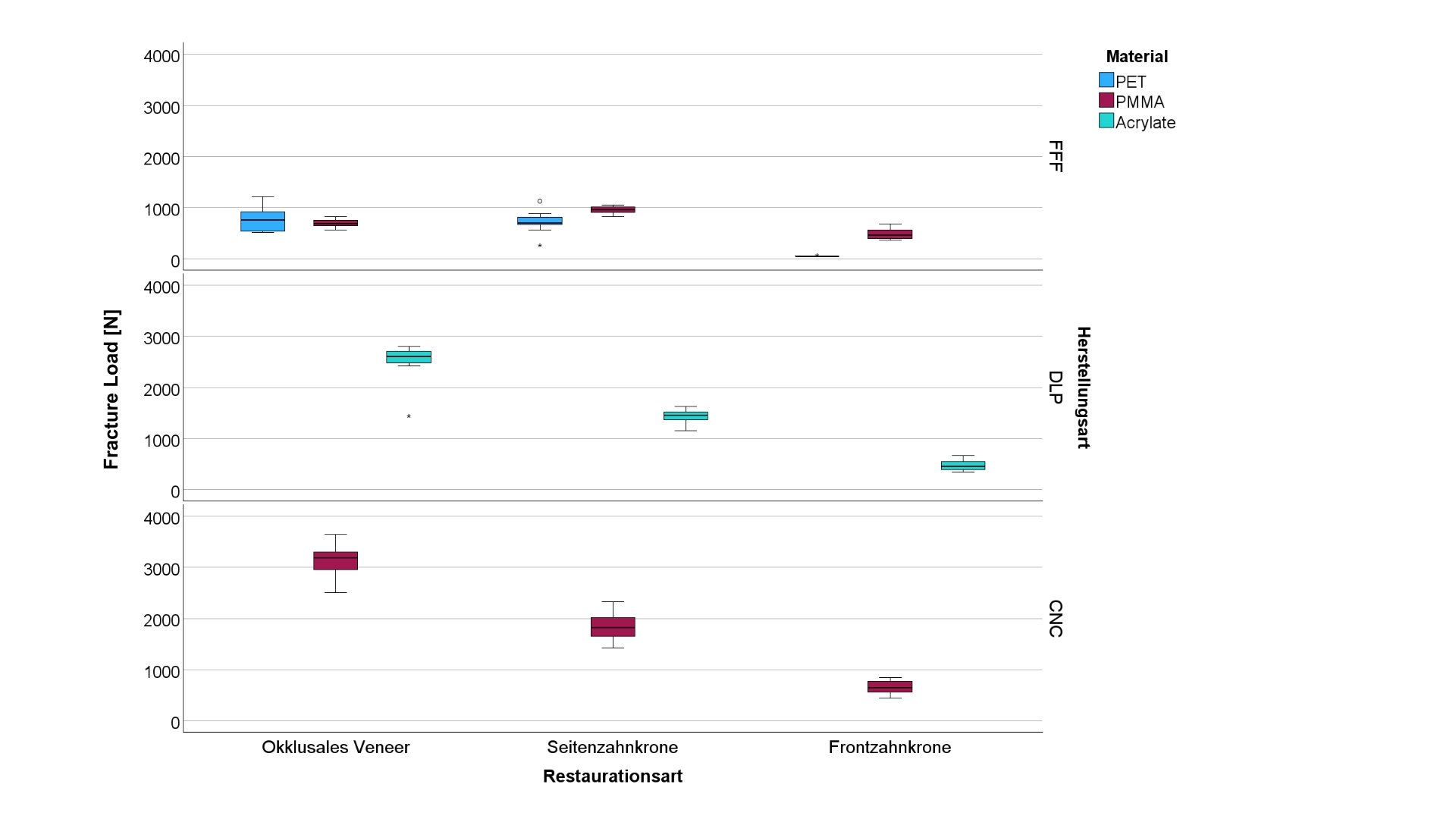
FFF-fabricated restorations exhibited the lowest fracture load values, while CAD/CAM-milled restorations showed the highest. For DLP and CAD/CAM restorations, occlusal veneers reached the highest fracture loads, while for FFF restorations, posterior crowns achieved the highest. Anterior crowns exhibited the lowest fracture loads regardless of the manufacturing method. Among the FFF restorations, PMMA achieved higher fracture loads than PET (Fig. 2).
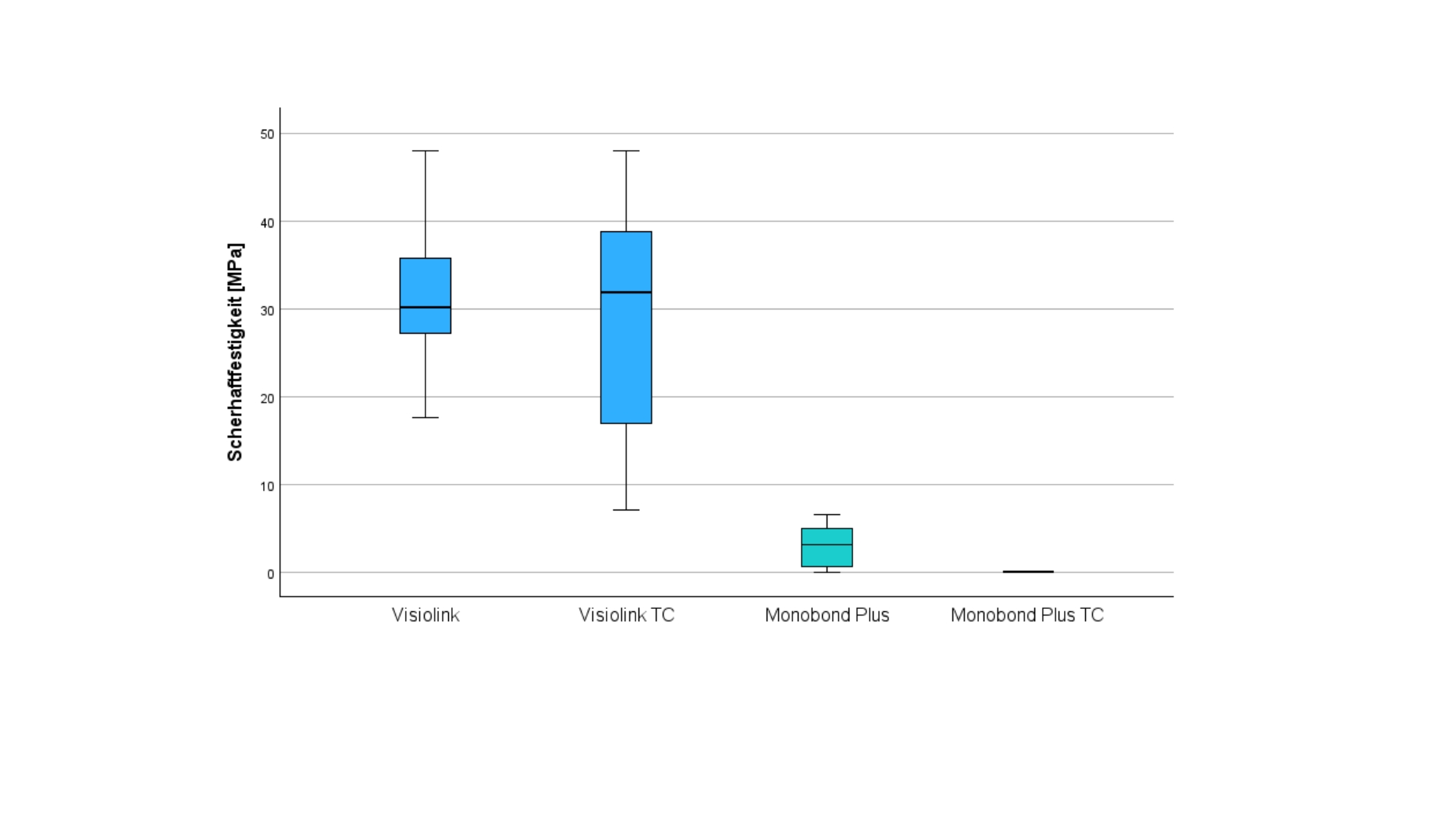
DLP-printed restorations showed the highest accuracy and reproducibility. 3D prints made from FFF-PET achieved accuracy comparable to CAD/CAM-milled restorations, while FFF-PMMA showed the greatest deviations. Visiolink achieved significantly higher shear bond strength values than Monobond Plus. While thermal stress cycling had no effect on Visiolink, all specimens conditioned with Monobond Plus detached during aging (Fig. 3).
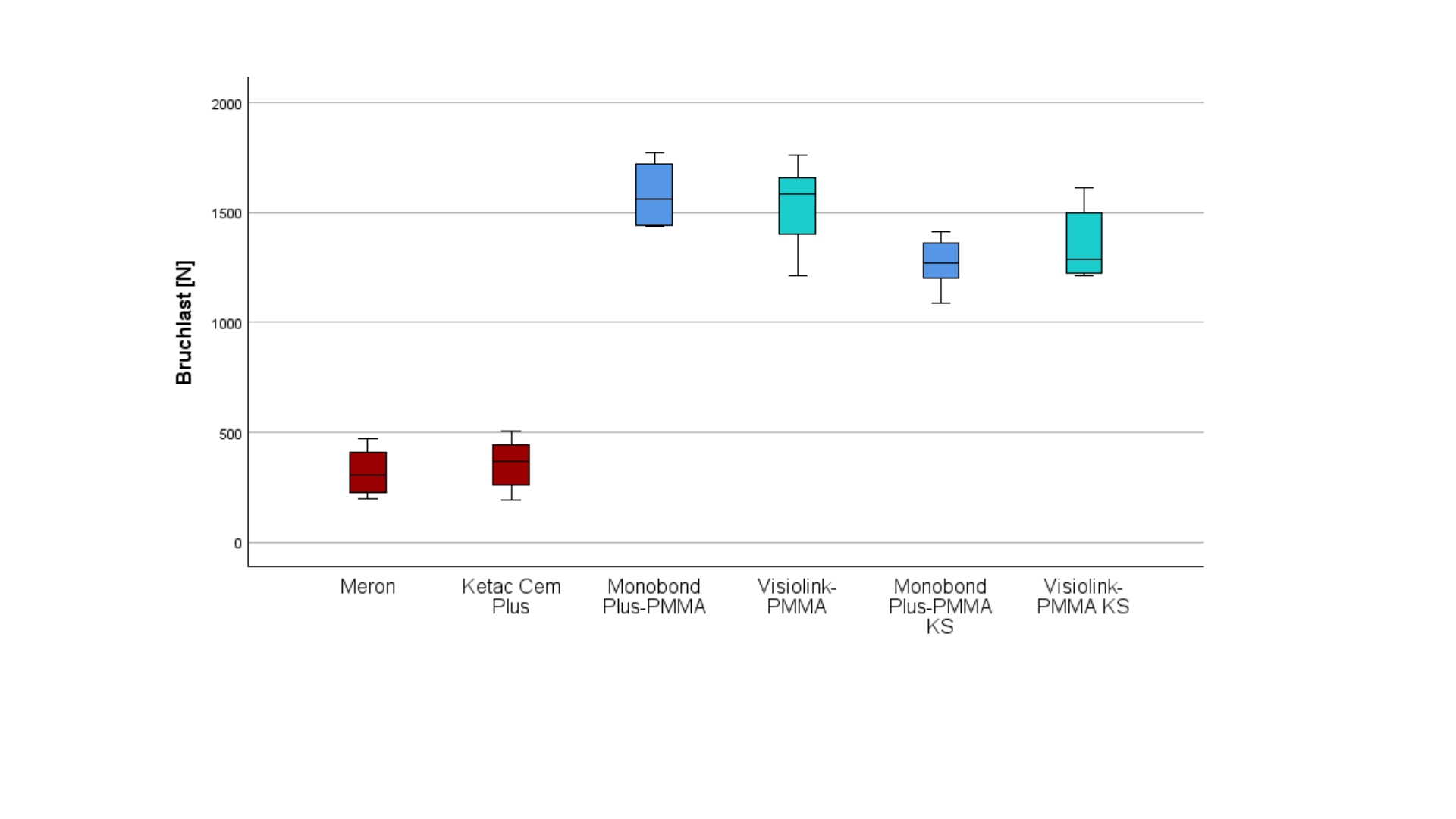
The luting material did not affect the fracture load in either PET or PMMA restorations. After chewing simulation, the fracture load decreased regardless of the luting material used (Fig. 4).
Conclusion
The results show that the manufacturing strategy has a decisive influence on the properties of provisional restorations. While CAD/CAM-milled restorations achieved the highest fracture loads, DLP exhibited the greatest accuracy and reproducibility. Among the FFF-fabricated restorations, PET achieved accuracy on par with CAD/CAM, whereas PMMA showed greater deviations. Visiolink proved to be a suitable adhesive system for PMMA. Considering the material- and process-dependent differences, FFF represents a promising alternative for the fabrication of provisional restorations.