

Extracted teeth are an important research material in dental research. However, before they are analyzed in the laboratory, they are usually stored for extended periods. This step can influence the measured material properties. A recent study shows the impact of storage media on the mechanical properties of dentin and why this factor should be considered when interpreting research results.
For in vitro studies, extracted human or bovine teeth are used to determine the mechanical properties or microstructural changes of dental hard tissue. These examinations are rarely performed immediately after extraction, which is why the teeth are usually stored for weeks to months in aqueous solutions with antibacterial additives. Typical solutions contain chloramine-T, thymol, or formalin. Less frequently, pure distilled water is used. It is known that the storage medium and duration can alter the mechanical properties of dental hard tissue. However, binding standards for storage are currently lacking, and existing studies are difficult to compare due to differing media, testing methods, and storage durations.
This is where the following study comes in, in which four common storage media were systematically examined to determine how they affect the mechanical properties of dentin over a period of up to 6 months (Figure 1).
The storage of extracted teeth can influence the measured material properties – a factor that is often underestimated in dental research.
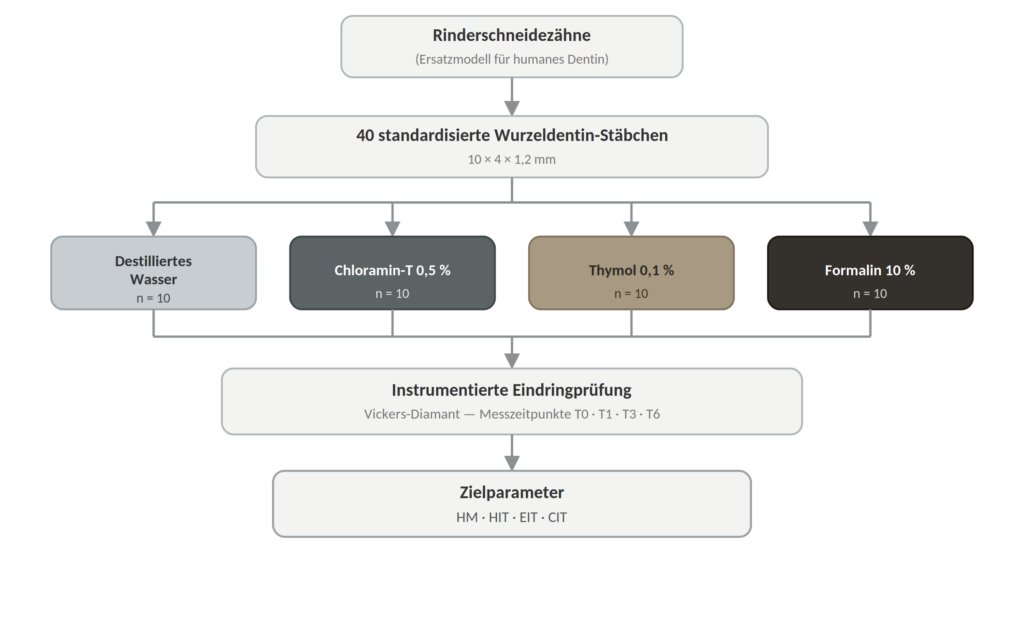
Bovine incisors served as substitute material for human dentin. They are characterized by lower sample variability and better availability compared to extracted human teeth and are therefore widely used in research. Forty standardized root dentin rods (10 × 4 × 1,2 mm) were prepared from the teeth and stored in batches of n = 10 in distilled water, chloramine T 0,5%, thymol 0,1%, or formalin 10% at 8 °C, protected from light. At the start of the study and after 1, 3, and 6 months, the Martens hardness (HM), indentation hardness (HIT), elastic modulus (EIT), and creep resistance (CIT) were determined using instrumented indentation testing.
Results
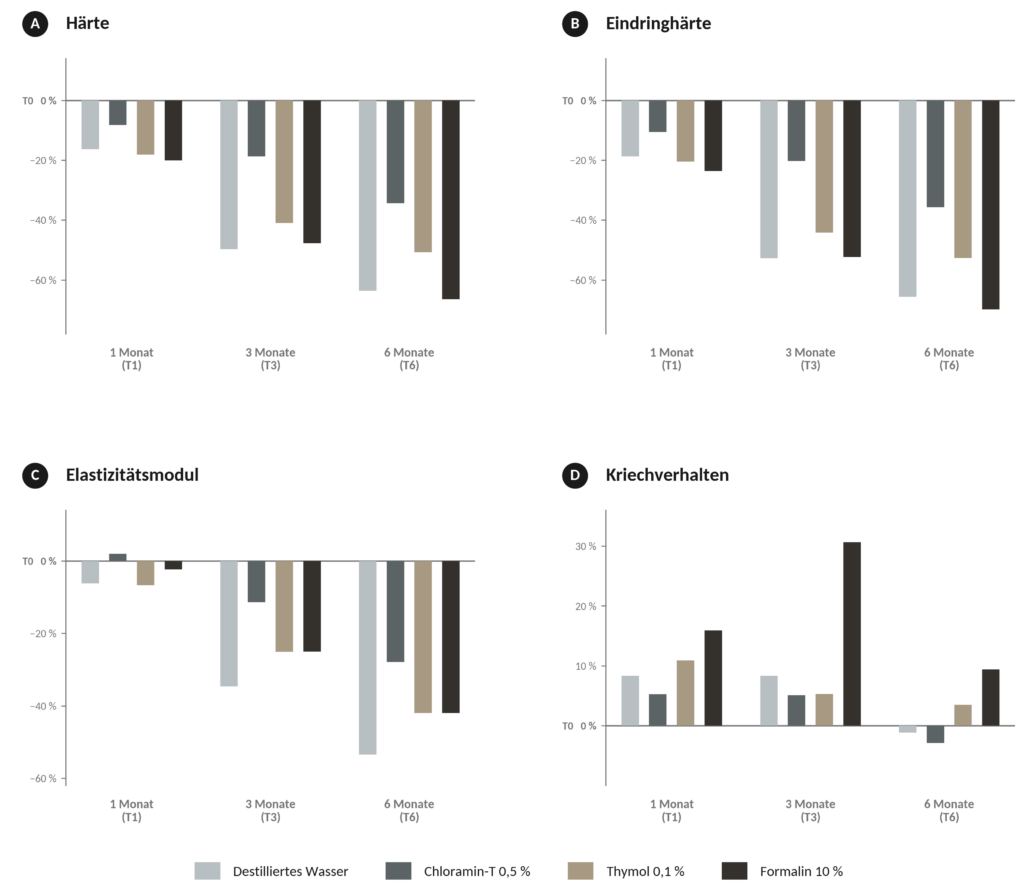
Across all four media, a significant decrease in hardness and modulus of elasticity was observed after a maximum of three months (Fig. 2). In direct comparison, the chloramine-T solution reduced the tested parameters the least compared to the initial value (T0). Creep behavior, i.e., the time-dependent deformation of a material under constant load, tends to increase, particularly in the first three months (T1, T3), compared to the initial value (T0). This effect is especially pronounced when stored in a formalin solution.
classification
These results confirm that the choice of storage medium is a relevant and often underestimated influencing factor in practice. The properties of extracted teeth change measurably within the first few months.
Distilled water, due to the lack of dissolved ions, leaches minerals from dentin. Formalin, on the other hand, alters the collagen structure of the hard dental tissue. Chloramine-T also leads to structural changes, but affects the measured parameters less than the other media examined.
Significance for practice, laboratory and research
Storage medium and duration should always be considered when planning in vitro studies on dental hard tissue. Many studies currently neglect the influence of the medium, which limits comparability. A standardized storage protocol would eliminate the influence of the storage medium. Until then, anyone interpreting study results on dental hard tissue should critically review the storage medium and duration of the samples examined.
examination
Herzog J, Klümke ML, Stawarczyk B, Klimenta M, Kanzow P, Rödig T, Haupt F. Impact of various storage media and time on mechanical properties of bovine root dentin. Sci Rep 2026;16:12182.