
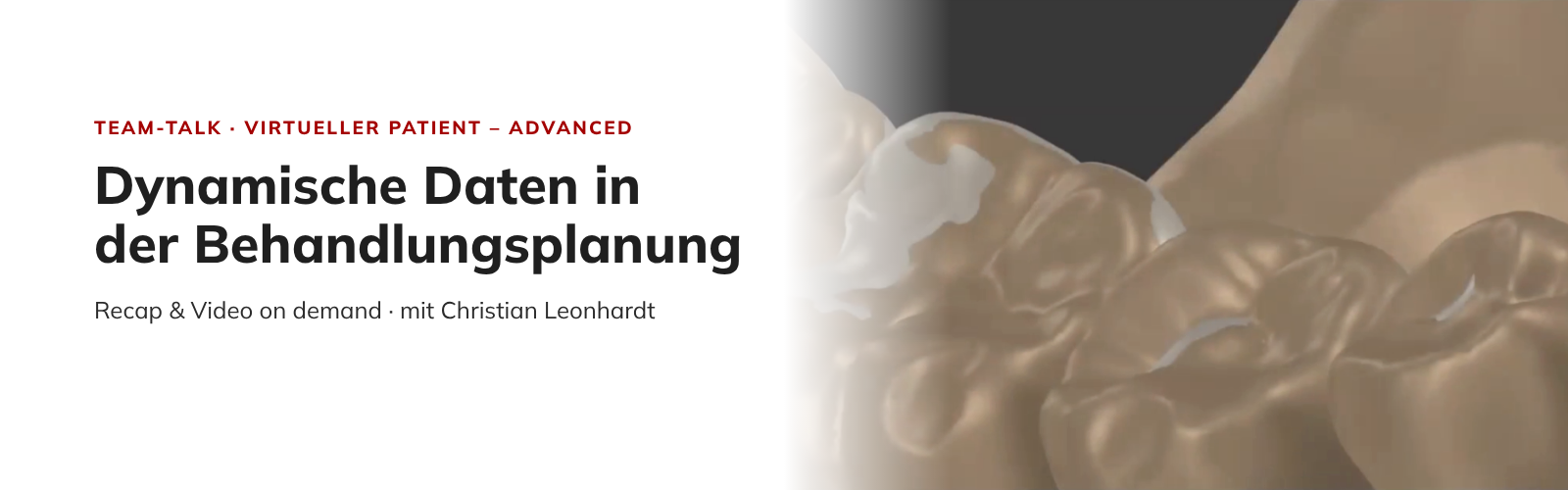
In the TEAM Talk – ADVANCED “Virtual Patient,” Christian Leonhardt shifted the focus from the question of which movement data can be digitally captured to its role in complex treatment processes. He demonstrated how aesthetics, function, periodontium, tooth structure, airway, and digital data can be integrated into treatment planning – and why a situation recorded once does not necessarily remain valid until the end of treatment.
The first TEAM Talk on the topic of virtual patients with Christian Leonhardt focused on what dynamic data can reveal in addition to the static situation. Part 2 – ADVANCED – picked up right where that left off: What does this knowledge mean for extensive rehabilitations? When do new data need to be collected? And how can we prevent technically sound planning from overlooking the patient's actual function? The recording of the TEAM Talk is available here.
Planning backwards – but from the patient's perspective
In complex cases, planning doesn't begin with the question of crown, implant, or material. The starting point is the desired outcome and whether this outcome is biologically and functionally achievable. Christian Leonhardt described a risk-based backward planning approach for this. Factors considered include aesthetics, function, periodontal condition, tooth structure, and—depending on the case—the airway. Only then can the most appropriate treatment option be determined.
Especially in implant planning, it is therefore not enough to simply determine the future implant position. Bone contour, emergence profile, and soft tissue are also planned backwards from the desired prosthetic outcome. In the case shown, for example, the bone contour was already surgically adapted to the future restoration.
- Complex rehabilitations begin with assessment and risk evaluation.
- Backward planning starts with the desired outcome and goes back to the necessary therapy.
- Prosthetics, implantology, orthodontics and function cannot be considered in isolation.
Function changes during treatment
A particularly important point of this TEM talk: Movement data is not a static quantity. In the first case shown, the chewing pattern had changed significantly after the provisional restoration. Therefore, the movement data collected at the beginning could not simply be used for the definitive treatment plan. After changes in bite, tooth position, or vertical dimension, the functional situation must be reassessed.
A similar situation arose in the second case. Following orthodontic pretreatment, a further dynamic measurement was taken. The planned prosthetic situation was initially tested with tabletops, snap-ons, or long-term temporaries – essentially as a "test drive" – before the final preparation and restoration.
- Movement data is always a recording at a specific point in time.
- If the functional situation changes, a new measurement may be necessary.
- Provisional phases can help to verify a planned function before the definitive treatment.
Clearance instead of predetermined guidance
Functional movement space already played a central role in the BASIC talk. In the ADVANCED talk, this became a concrete planning parameter: clearance. This refers to the free space the patient needs when chewing, speaking, and swallowing so that the tooth shapes don't constantly interfere with each other. By superimposing classic articulator movements with real movement data, Christian Leonhardt demonstrated that significantly different clearances can be required even with the same static starting point. This is directly relevant for dental technicians. If this space is lacking, an aesthetically pleasing morphology can certainly be designed – but it may not correspond to the patient's actual movement.
In the subsequent discussion, Christian Leonhardt formulated his position very clearly: the goal is not to guide the lower jaw through the most pronounced possible guides, but to avoid interferences in the natural movement sequences.
- Static occlusion alone does not fully describe the required functional space.
- Clearance refers to the necessary space for movement between the rows of teeth.
- Knowing this free space before preparation and manufacturing can be crucial for the design.
Natural Head Posture – truly a reliable reference?
Another focus was head posture. The natural head posture is frequently used as a reference for patient orientation in digital and analog workflows. However, in the TEAM-Talk, Christian Leonhardt raised the question of how stable this reference actually is. His point: head posture changes through adaptation and compensation, including in relation to breathing, bite, and function. Therefore, for face scans and other digital datasets, it is not sufficient to simply create a three-dimensional image of the head. The reference system to which this position is related is also crucial.
Instead of an unchanging “Natural Head Posture”, he advocated thinking more in terms of an “adapted head posture”: a posture that is the result of individual adaptation processes.
- Head posture is relevant for the spatial orientation of digital datasets.
- It should not automatically be considered a permanently constant reference.
- Face scans and 3D datasets require a verifiable reference system.
Planning takes time and communication.
In the end, the discussion moved away from devices and data sets and back to the treatment process.
For complex cases, Christian Leonhardt recommends a sequential approach: First, acute problems are stabilized. This is followed by the actual planning phase, involving renewed data collection and coordination between the patient, the dental practice, and the laboratory. Surgery, orthodontics, or long-term temporary restorations represent further intermediate steps before the definitive treatment begins.
Especially in lengthy treatment processes, communication itself becomes part of the treatment planning. Patients need to know where they are in the process, why certain intermediate steps are necessary, and what the goal is. Dental technicians should also be involved early on, not just when the final restoration is to be produced.
- Complex rehabilitations benefit from clearly separated treatment phases.
- The planning should be completed and agreed upon before execution.
- Practice, laboratory and patient need the same orientation throughout the entire treatment process.
What are the takeaways from the TEAM talk “Virtual Patient”?
The second TEAM talk on the topic of "Virtual Patient" made it particularly clear that the (virtual) patient is not a finished data set. The patient changes during treatment, and therefore movement, bite, head posture, and functional range of motion can also change.
Digital technologies help to make these changes visible and measurable. However, the crucial step remains the classification: What data do I need at what time, and what are the implications for my planning?
For those who missed the TEAM-Talk ADVANCED or would like to review individual topics: The recording is available here as video-on-demand.
Our TEAM Talks are intentionally freely accessible. This is made possible by the commitment of the members of EADT e.V. and the voluntary work of the board. Those who would like to support this work can find further information about membership here.