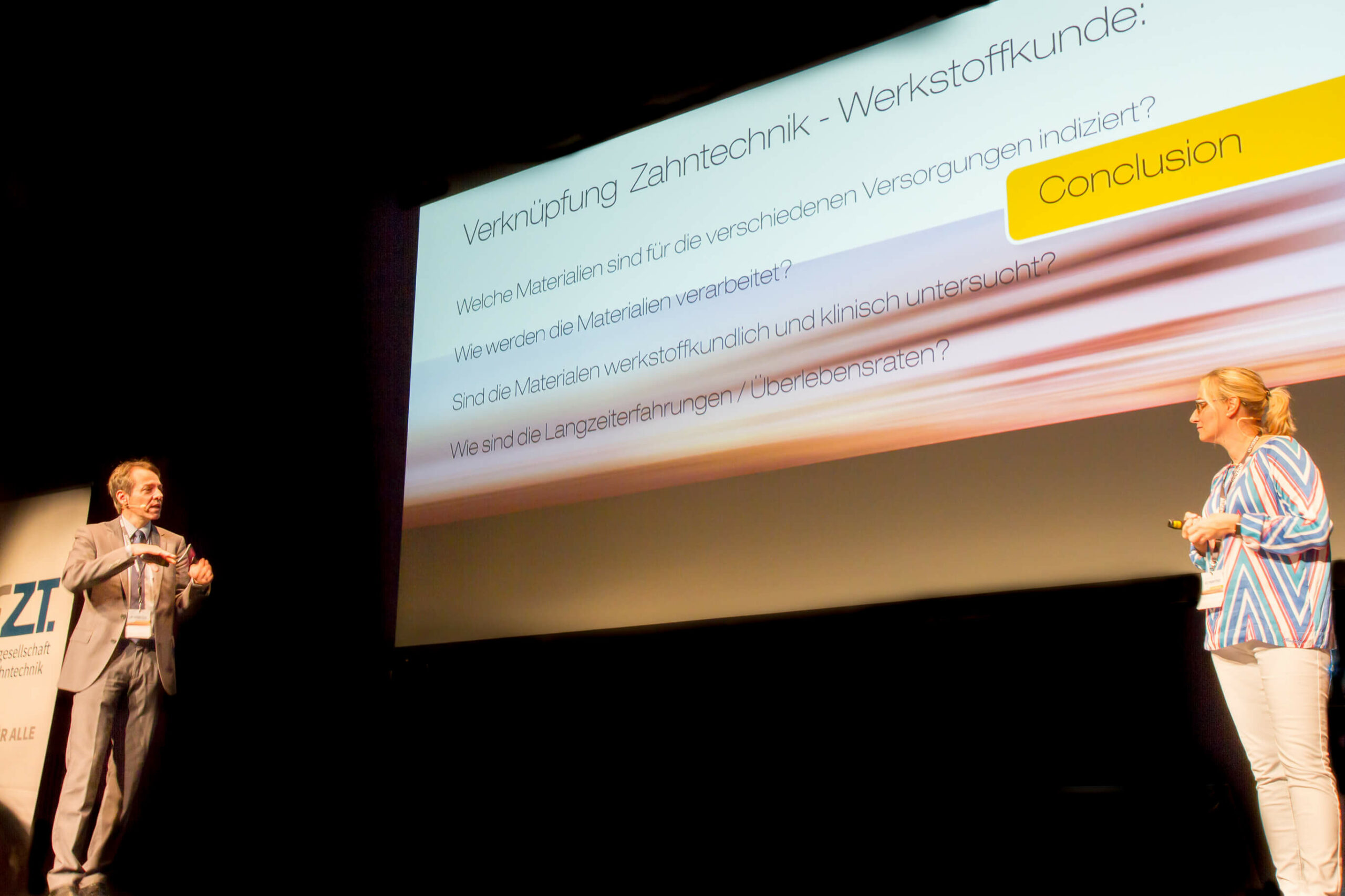
The 9st Expertise Dental Technology Congress took place on September 10th and 2016th, 1. More than 250 trade visitors accepted the invitation to Kornwestheim and experienced the first-class congress program. The organizers were five dental technology societies that pooled their strengths under the umbrella of the FZT (Special Society for Dental Technology).
- dental excellence network
- FDZt (specialist society for digital dental technology)
- VFDTz (Association for the Promotion of Digital Dental Technology)
- EADT (European Association of Dental Technology)
- Forum for dental technicians of Dentista eV
WE DESIGNED THE “PRACTICE AND SCIENCE” PROGRAM PART.
Excerpts from our lectures:
Material science: adhesive connections
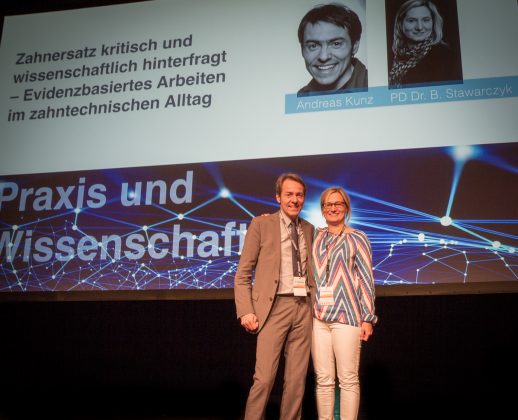
Dental technician Andreas Kunz and PD Dr. Bogna Stawarczyk gave a joint presentation. "We dental technicians must engage with the scientific data. Only then will our work be respected by dentistry," said Andreas Kunz . Bogna Stawarczyk addressed, among other things, the various luting materials and their chemical bonding to zirconium oxide. Acidic monomers modified with phosphate groups, as well as the well-known MPD monomer, can chemically bond to zirconium oxide. Basically, all self-adhesive luting composites contain these acidic monomers. Conventional luting materials also use intermediate bonding agents—silanes or primers—which neutralize the acidic monomers.
Groups included, required. The speaker warned: “Caution: We have to look at what the silanes and primers are made of.” Silanes with MPS groups bind well to glass ceramics and increase the wettability of the zirconium oxide. But only silanes with MPD-containing or phosphate-modified monomers chemically adhere to zirconium oxide. If mixed up, the materials can, in the worst case scenario, act as an insulator!
Material science: zirconium oxide
Another interesting topic was zirconium oxide. Zirconia is not zirconium oxide! Even if the material often comes from the same raw material supplier, the qualities can differ due to the pressing and sintering parameters. “The sintering parameters are often firmly integrated into the sintering furnace and are not known to the user,” criticized Andreas Kunz. “And especially with the 1st and 2nd generation of zirconium oxide, the optical but also the mechanical properties of zirconium oxide can be strongly influenced,” emphasized PD Dr. Stawarczyk.
Fixed prosthetics
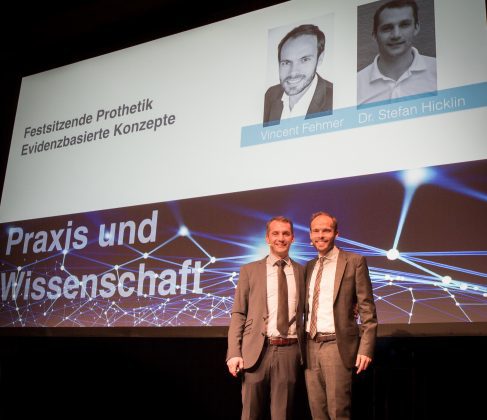
ZTM Vincent Fehmer and Dr. Stefan Hicklin spoke about “Fixed Prosthetics: Evidence-Based Concepts”. Clear statement: VMK technology is still the gold standard. The all-ceramic concepts must be able to measure themselves against this. The main problem is the veneering ceramic, the solution to which could result in monolithic concepts. However, these are not yet evidence-based. “There is much to suggest that the monolithic supply can work if the processing parameters are adhered to,” says Vincent Fehmer.
Implant abutments
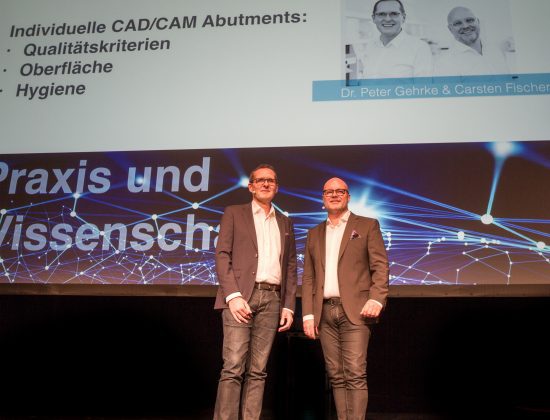
ZT Carsten Fischer and Dr. Peter Gehrke spoke about the cleaning and hygiene of implant prosthetic components. By definition, abutments are medical devices and are classified as semi-critical or critical according to RKI guidelines. However, it has been proven that there can be contamination on implant abutments that jeopardize long-term stable results. For the treatment team, this means that all implant components should be cleaned according to a professional protocol. Pure evaporation or cleaning with alcohol does not adequately meet these requirements. The speakers presented a validated cleaning protocol that results in a clean and hygienically perfect abutment surface. The discussion sparked the explosive question of whether the individual implant prosthetic component had to be sterilized in the laboratory and, if so, what happens to the bonded zirconium oxide cap during treatment in the autoclave. According to Peter Gehrke, there is a risk that the material could be degraded as a result.
Conclusion
A statement for dental technology! The Expertise Dental Technology Congress followed a common thread and told a story that can become reality: dental technology based on scientific facts and legally secured with patient contact. The self-contained program showed everyday laboratory life with many facets - contemporary dental technology that combines technical aspects with digital tools without losing sight of proven values.
Annett Kieschnick, specialist journalist
(The full congress report will soon be available in DZW or at www.dentaletexte.de )