

Bogna Stawarczyk, Annett Kieschnick, Martin Rosentritt
A wide variety of CAD/CAM materials for the production of dentures has emerged in recent years. The article provides a brief overview of polymer-based materials that can be processed subtractively.
An advantage of polymer-based CAD/CAM materials is due to industrial production (hardening under elevated temperature and high pressure) and the associated increase in quality. Compared to chemical or light-curing polymers, CAD/CAM materials have higher homogeneity and improved mechanical material properties.
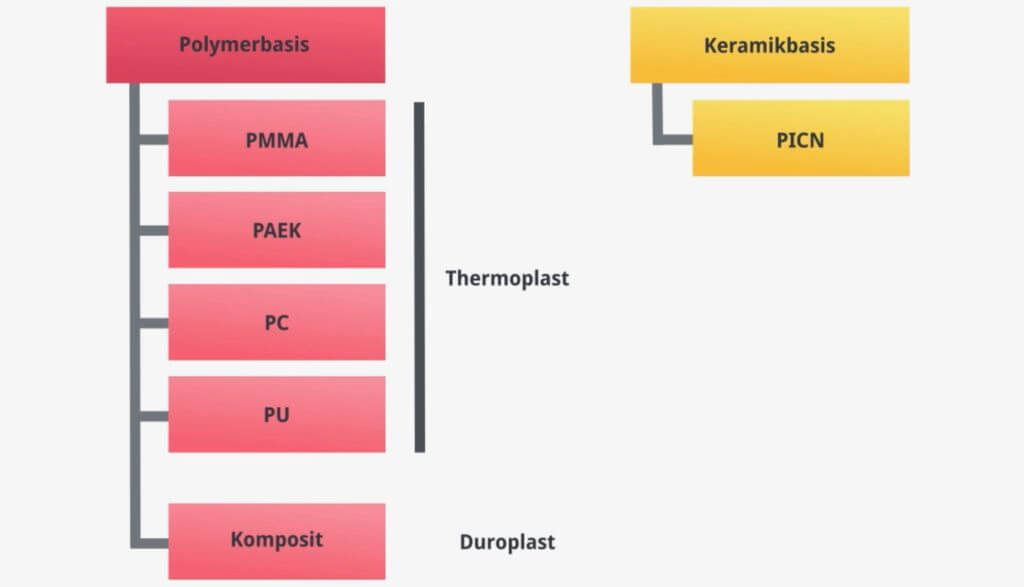
Common polymer-based CAD/CAM materials in dentistry are:
- Polymethyl methacrylate (PMMA)
- Dimethacrylate-based composites (DMA)
- Polyaryl ether ketones (PAEK)
- polycarbonate (PC)
- Polyurethanes (PU)
- Polymer-infiltrated ceramic (PCIN)
The materials can be classified according to indication areas - temporary or permanent restorations, therapeutic aids (splints), auxiliary structures (e.g. models, drilling templates, positioning aids).
PMMA based plastics
CAD/CAM PMMA materials have a strength of around 100 MPa. The elastic modulus is 2-3 GPa. The blanks are available in monochrome or as a multilayer version in several colors. PMMA plastics are generally used for temporary restorations or as a splint or prosthesis base material. The indication areas for these materials extend to temporary multi-unit bridges (with up to a maximum of two pontics).
CAD/CAM composites
The strength of CAD/CAM composites is approximately 100 MPa and the elastic modulus is 10-18 GPa. These blanks are also available as a monochrome version in several colors. CAD/CAM composites are used for permanent fixed single tooth restorations. Some manufacturers mistakenly market CAD/CAM composites under the name “ceramics” (e.g. “nano(hybrid) ceramics”) because they contain a high proportion of inorganic fillers.
Polyaryl ether ketones (PAEK)
PAEK materials exhibit tensile strengths up to approximately 160 MPa and a modulus of elasticity between 3,5 and 5 GPa. PAEK materials are further subdivided into subgroups (PEEK, PEKK, AKP). The mechanical properties of these polymers are primarily determined by the number of ketone and ether groups, as well as the doping with other components. Unfilled PEEK is indicated for removable prosthetics. The material is opaque and non-translucent. Filled PEEK and PEKK are used for fixed and removable dentures. AKP is indicated for clasp-retained dentures. More information: Link
Polymer-infiltrated ceramics (PICN)
Polymer-infiltrated ceramics show strength values of up to approx. 120 MPa. The elastic modulus is approximately 30 GPa. Contrary to its nomenclature, polymer-infiltrated ceramic (PICN) is not ceramic either. It is a spongy base substance made of glass ceramic that is infiltrated with monomers such as TEGDMA and UDMA (around 86% by weight of ceramic). PICN cannot be veneered with ceramic. The indication is single tooth restorations.
polycarbonate (PC)
Polycarbonates are classified as thermoplastics and are often used for rails due to their elastic properties. The materials have a high translucency and are available in tooth colors. A chemical bond between polycarbonates and other plastics (veneering or fixing composites) is only possible to a limited extent due to the different chemical composition. Therefore, polycarbonates are mainly used for temporary monolithic restorations and splints.
Polyurethanes (PU)
Polyurethanes (PU) are usually used to make models. They are formed when dialcohols react with polyisocyanates.
Conclusion
Who's who - the fundamentals of materials science make it easier to select the material for the respective indication. Preparation guidelines, the processing and treatment of the material as well as the correct fixation strategy are crucial for clinical success. Complete version of the article in Quintessenz Zahntechnik 11/2018.