
Welcome to EADT eV TEAM Talk #9, "The Emergence Profile – The Transmucosal Interface." The emergence profile is one of those topics that has become almost commonplace in implant prosthetics. But what seems obvious is rarely questioned. We dedicated our TEAM Talk in January 2026 to this very topic.
Often, the emergence profile is reduced to a question of shape: concave or convex, narrow or wide, aesthetic or functional. Shapes, angles, and materials are discussed—usually with great certainty. But the fundamentals on which these decisions are based are frequently overlooked. The EADT eV's TEAM Talk #9 opened up this area of tension. Not with the aim of providing definitive answers, but to highlight the challenges. A central component of the TEAM Talk was the contextualization of current research and its application in everyday practice and laboratory work. More than 50 registrations and a focused, technically demanding discussion demonstrated the high demand for such information. The recording of the TEAM Talk is available here.
- Studies have shown that steep emergence angles in the crestal area are associated with an increased risk of inflammation and bone loss – regardless of aesthetics.
- “Forced” emergence profiles are often an expression of a lack of space (vertical/horizontal), not creative design.
- A biologically stable emergence profile is usually unremarkable – conspicuous forms are often an attempt at compensation.
The emergence profile is not a detail – it is a system.
During the TEAM discussion, it became clear that the emergence profile is not created in a single step. Rather, it is the result of a chain of decisions that begin before implantation and continue through surgery, prosthetics, material selection, and dental technology. Implant position , vertical and horizontal space, soft tissue quantity and quality, shaping strategy, material properties, surface preparation, and the workflow between the practice and the laboratory are all interconnected. If any one of these factors is underestimated, compromises arise that are later difficult to biologically "repair."
- Problems with the emergence profile are in many cases positional problems (implant depth, vestibular bone, axis direction) – not design problems.
- Emergence profiles should be considered preoperatively, especially in cases of limited vertical soft tissue space.
- Later prosthetic “corrections” can rarely compensate for unfavorable conditions, but merely shift risks.

Biology cannot be outsmarted.
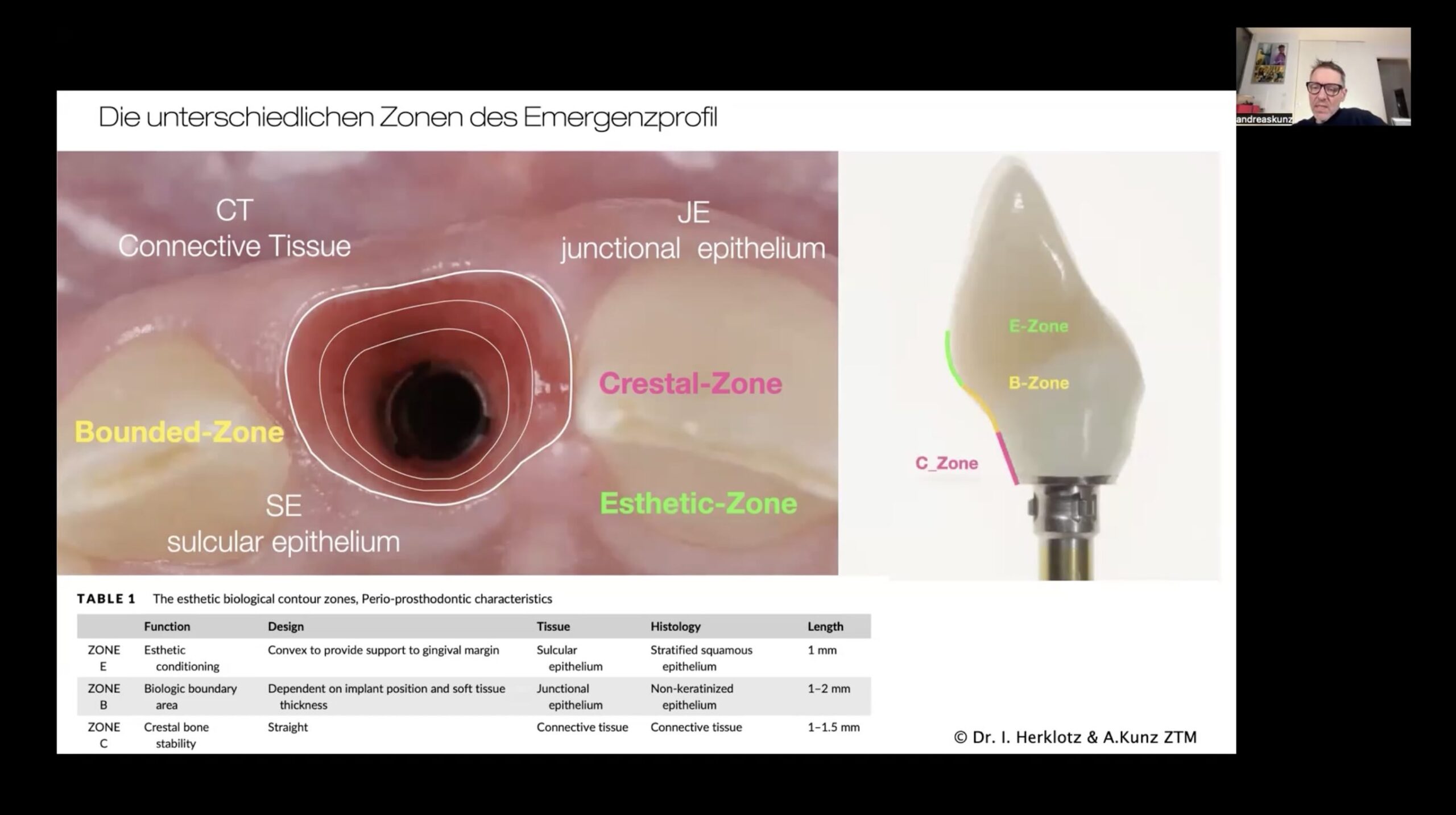
One topic of discussion was the soft tissue itself. The key takeaway: soft tissue reacts biologically, not mechanically. Pressure, unfavorable angles, or overly aggressive contours can lead to stress reactions – with well-known consequences such as recessions, inflammation, or peri-implant bone loss. The TEAM Talk addressed the existing research on emergence angles, soft tissue zones, and pressure relationships, and compared it with clinical experience. Modern concepts view the emergence profile as zoned and functionally differentiated – not as a homogeneous form.
- Tissue displacement should occur coronally and laterally, not apically.
- Critical zones are located crestally: Here, angles and transitions determine long-term stability.
- Rapid, form-dominated shaping increases the risk of biological complications – even with technically sound work.
Material choice is not a matter of ideology
The discussion surrounding abutment materials was deliberately de-emotionalized. Titanium, zirconia, hybrid abutments, and materials such as PMMA or PEEK were not evaluated as "good" or "bad," but rather categorized according to their indications. Mechanical stability, esthetics, plaque affinity, surface quality, and workability were considered within the clinical context and discussed in light of the available evidence.
- Mucosal thickness and implant position are crucial for material selection.
- Hybrid abutments They require controlled adhesive joints and sufficiently long titanium bases; otherwise, the risk of fracture increases.
- Industrial prefabrication does not replace dental post-processing, especially in biologically sensitive areas.
- Every single step in the production of the abutments follows a clear protocol.
The role of the laboratory: crucial, but often underestimated
From a dental technology perspective, there was a clear consensus: there is no such thing as a "ready-to-use" abutment. Manufacturing residues, adhesive residues, and insufficiently polished surfaces are relevant biological risk factors. The TEAM Talk highlighted how closely materials science, surface treatment , cleaning , and biological reactions are intertwined, and how important coordinated processes between dental practice and laboratory are.
- Each abutment should be reworked and thoroughly cleaned will be, regardless of the manufacturing process.
- Surfaces in the emergence zone are more critical to assess than supragingival areas.
- Binding Cleaning and handover protocols The interaction between practice and laboratory is part of biological quality assurance.
Digital workflow: helpful – but time-critical
The TEAM Talk also revealed that digital processes are precise but not error-tolerant. Scanning the formed emergence profile proved to be a particularly critical moment. Studies and measurements show that soft tissue collapses immediately after removal of the gingival former – resulting in measurable information loss within a very short time.
- The scan timing is a biologically relevant process step – not an organizational detail.
- Digital workflows only work if they are biologically understood and actively controlled.
The emergence profile only works in a team setting.
TEAM Talk #9 was presented by a trio who embody this very interplay: Felicitas Mayinger (dentistry), Andreas Kunz (dental technology), and Carsten Fischer (dental technology). All three have been active in the EADT e.V. for years and exemplify the association's credo: taking scientific evidence seriously, critically evaluating it, and consistently translating it into everyday practice and laboratory work; without dogma, but with professional clarity.
TEAM Talk #9 is now available as video on demand.
The complete discussion, including all expert classifications, study references, clinical examples and controversial perspectives, is now available as video on demand.
Our TEAM Talks are intentionally freely accessible. This is made possible by the commitment of the members of EADT e.V. and the voluntary work of the board. Those who would like to support this work can find further information about membership here.