
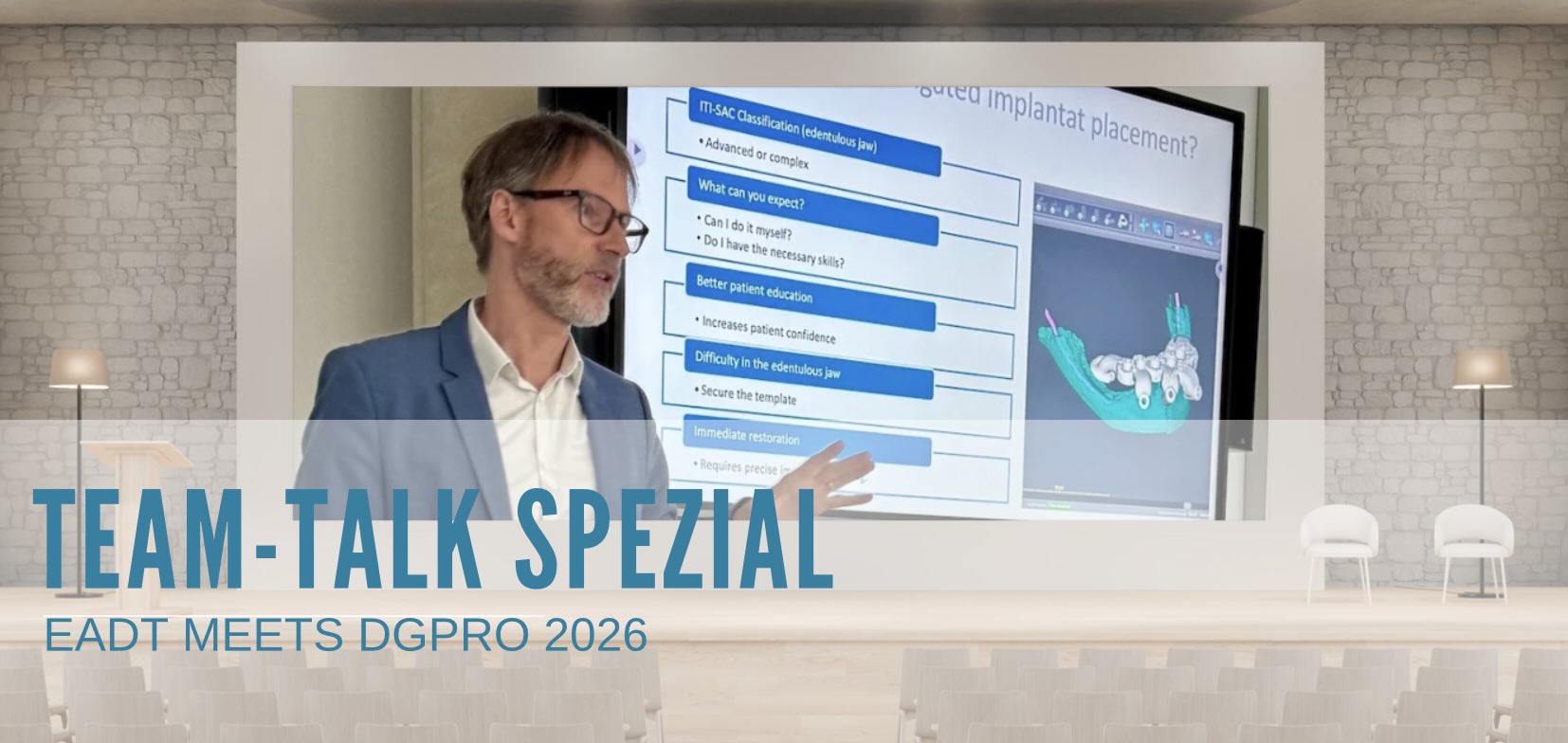
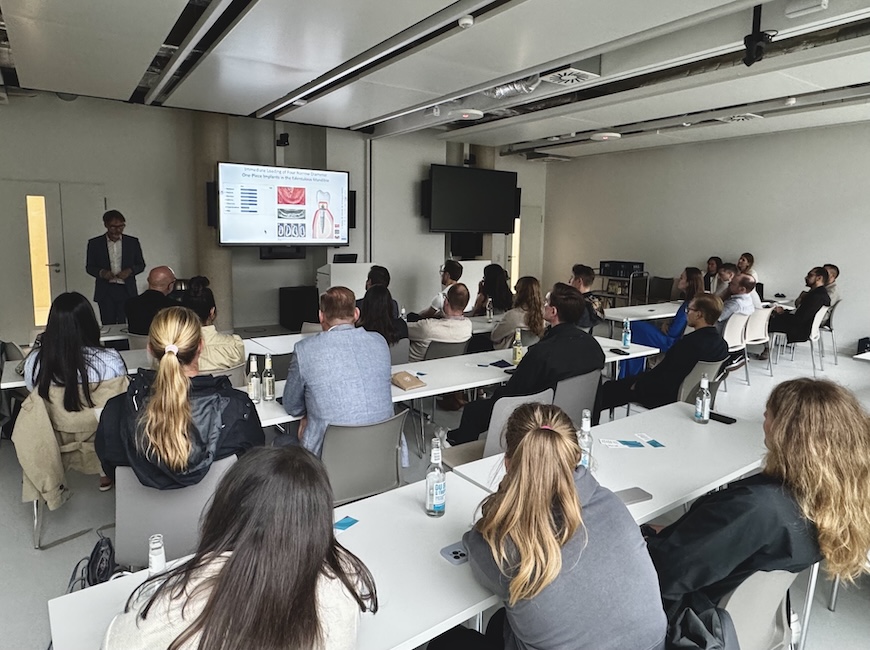
The edentulous upper jaw is considered one of the most challenging cases in implant prosthetics – both technically and personally. At the TEAM-Talk Special 2026 in Bonn, Prof. Dr. Stefan Wolfart demonstrated how closely evidence, the patient's perspective, and clinical practice and laboratory work are intertwined.
The number of edentulous patients is declining, yet the edentulous upper jaw remains a prominent topic at every major conference. Prof. Dr. Wolfart used this apparent contradiction as a springboard for a fundamental stance during the TEAM Talk: Implantology should be a solution for genuinely edentulous patients – not a reason to render patients edentulous. He deliberately placed this message at the beginning because it emphasizes the shared responsibility of dentistry and dental technology: Every treatment decision begins with the question of what is truly necessary for this individual, not merely what is feasible.
The patient's perspective first
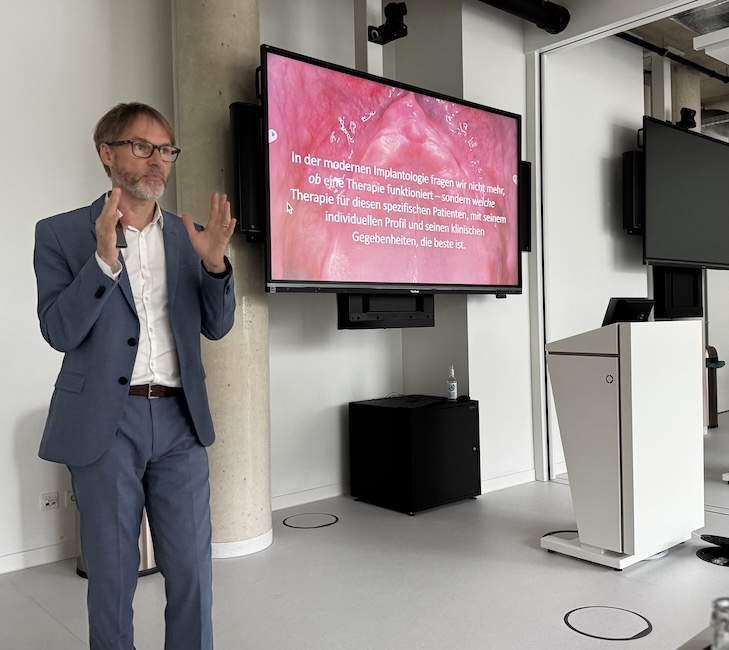
A widely cited study from the 1990s revealed the profound impact of tooth loss on those affected. Statements like "the end of the world" or "the loss of self-confidence" illustrate that for patients, dental prosthetics are not merely a technical matter, but a deeply personal one. This is precisely where Stefan Wolfart's message comes in: the scientific question is no longer whether implant therapy works, but rather which form of therapy is optimal for the individual patient's profile.
The patient profile as a basis for decision-making
He presented a model from a current ITI Treatment Guide that bases the treatment decision on a multidimensional patient profile: desire for surgical invasiveness, desired function and stability, aesthetic requirements, available tissue, financial resources, and the individual risk of implant failure (e.g., due to smoking, a history of periodontitis, or inadequate oral hygiene). The interplay of these factors determines whether removable or fixed prostheses are appropriate, how many implants are needed, and which retention element is suitable.
Patients with a history of periodontitis have an increased risk of implant failure. Patients must be informed about this increased risk – a point also enshrined in the current guidelines.
Fixed or removable – a question that is often asked too early.
The speaker emphasized the importance of not presenting patients with the choice between "fixed or removable" too early or across the board. A study in which patients wore both types of prostheses for eight weeks showed that the majority ultimately opted for the removable version, citing factors such as improved speech function and ease of cleaning. With fixed prostheses that use connectors, this can be limited due to their design. Wolfart did not use the study as a general recommendation for removable prostheses, but rather as an indication of how strongly individual priorities can influence the decision. This connection was vividly illustrated by a video of a computed tomography scan performed during speech. It demonstrated the impact that prosthesis design can have on phonetics.
The degree of atrophy determines the holding element
For removable prostheses, the following applies: Ball or locator attachments are well-suited for mild to moderate atrophy. In cases of pronounced atrophy—with correspondingly long lever arms—bars or telescopic crowns are often the more robust choice, as they can be guided parallel to each other and primarily lock the implants in place. Stefan Wolfart illustrated this with the case of a patient with two locators in the mandible who had barely been able to eat for years. The solution using two telescopic crowns restored her quality of life. The number of implants actually required depends on the patient profile. The speaker referred to the work of Matthias Kern, which shows that, with correspondingly low functional demands, a single implant with a ball or locator attachment can be a sensible option in the mandible. In the maxilla, the initial situation is generally more challenging.
Fixed implants: four implants as a minimum, good distribution is crucial
According to Wolfart, four well-distributed implants form the basis for fixed restorations in both the upper and lower jaw. Wolfart compared three systems for implant fixation:
- cementingThis allows for a tension-free fit (passive fit), but has the disadvantage of being difficult to remove, a problem given the frequency of peri-implantitis over the treatment period. Cementation margins should be supragingival or only minimally subgingival; with increasing subgingival depth, the risk of overlooking cement residue increases.
- Angled screw systemsThese allow for significant angle compensation, but vary depending on the manufacturer. Documenting the screwdriver used is important; ideally, this should include handing it over to the patient.
- Multi-unit abutmentsThey offer a high degree of planning reliability and are particularly predictable with complex angularities. However, the platform height must be carefully planned.
Material selection: Evidence before hype
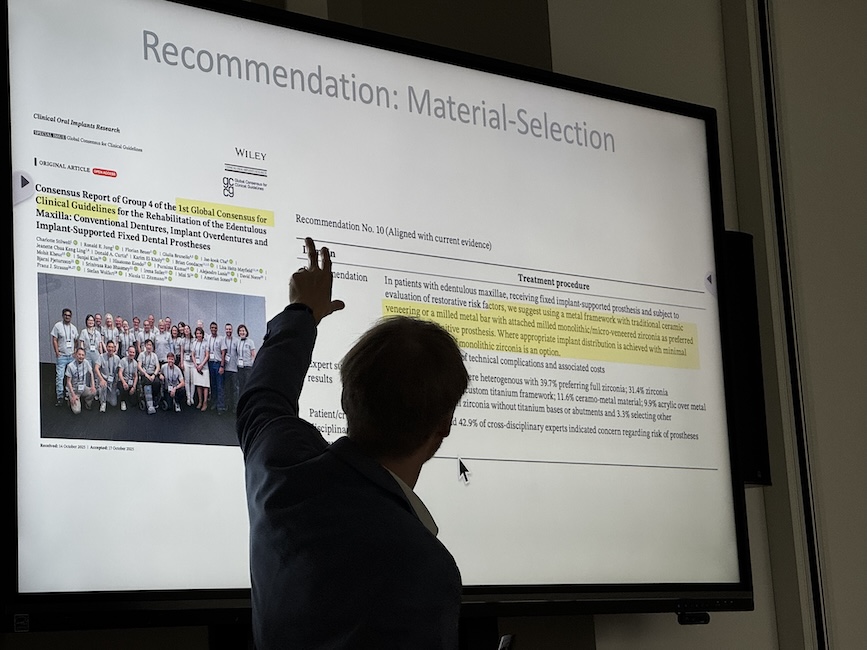
One focus was on the current international consensus guideline for edentulous maxilla restorations. The recommendation for fixed full-arch restorations is: metal-ceramic or a titanium bar with a monolithic or micro-veneered zirconia superstructure. A purely monolithic zirconia bridge without a bar is only recommended if the implants are well-distributed and connecting elements are avoided. According to studies, cantilevers and pontics are particularly prone to fracture.
Stefan Wolfart's openness regarding the available evidence was noteworthy: Reliable long-term data currently exist primarily for first-generation zirconia (3Y-TZP), while corresponding studies are still pending for the more translucent variants commonly used today. Instead of deriving a ban from this, he advocated a thoughtful approach to this uncertainty. A recommendation, he explained, is not dogma, but rather the best common denominator currently agreed upon by an international panel of experts. Metal-ceramic restorations thus remain a safe option – despite the risk of chipping.
Digital planning meets analog experience
Stefan Wolfart also demonstrated how digital planning (CBCT-based drilling templates, immediate impressions using markers) and classic dental laboratory steps (verification index, wax-up transfer) work together. The starting point is always the prosthetic goal: first the setup, then the implant positions. This backward planning only works if surgery, prosthodontics, and dental technology think together from the very beginning.
His conclusion regarding the technological question of intraoral data acquisition: Optical impressions, when implemented well, are on par with conventional methods, but should not be an end in themselves. The crucial factor is not the tool, but a well-coordinated team that has mastered the respective method. Immediate loading, in particular, has become significantly more predictable thanks to digital workflows, but precisely for this reason, it requires even greater coordination between disciplines.
More than just a question of implants
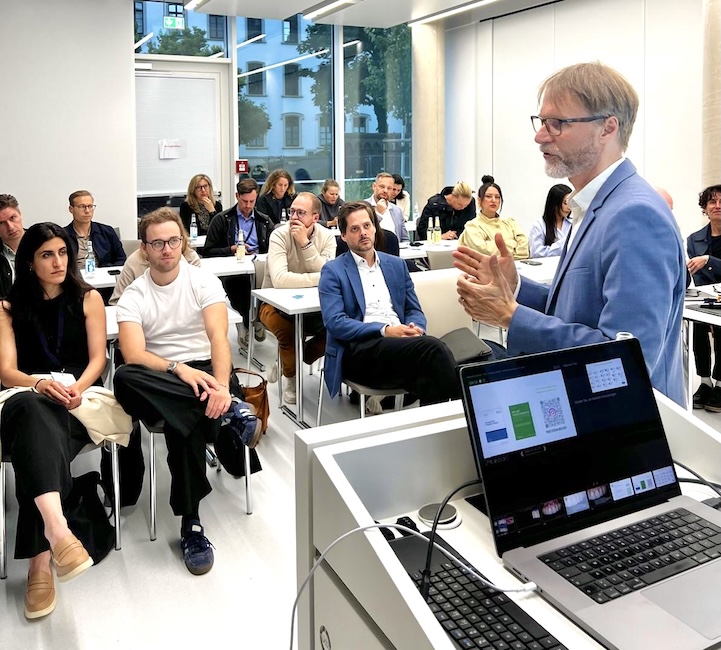
The TEAM-Talk Special 2026 made one thing clear: there is rarely a single right solution for edentulous maxillae. Crucial factors are the individual patient profile, a careful consideration of treatment options, and the interplay of surgery, prosthetics, dental technology, and materials science. Implants should be a solution for edentulous patients – not the reason for making patients edentulous. The question of "fixed or removable?" should not be asked too early. And when it comes to material selection, evidence trumps hype.
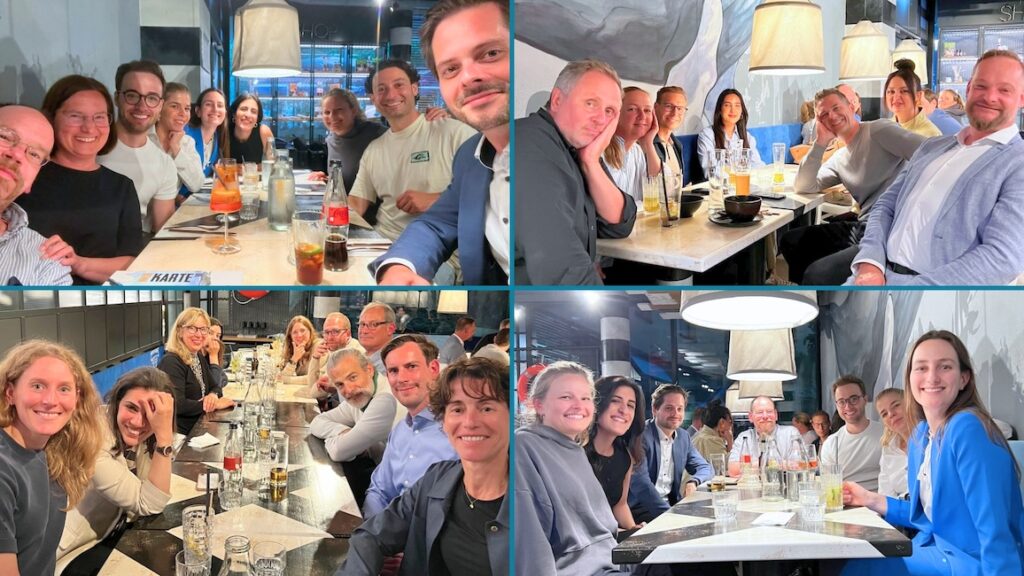
The exchange at TEAM-Talk didn't end with the last slide. The shared dinner talk provided ample time for personal conversations, new contacts, and networking between practitioners, labs, researchers, and industry – all without a set agenda.