
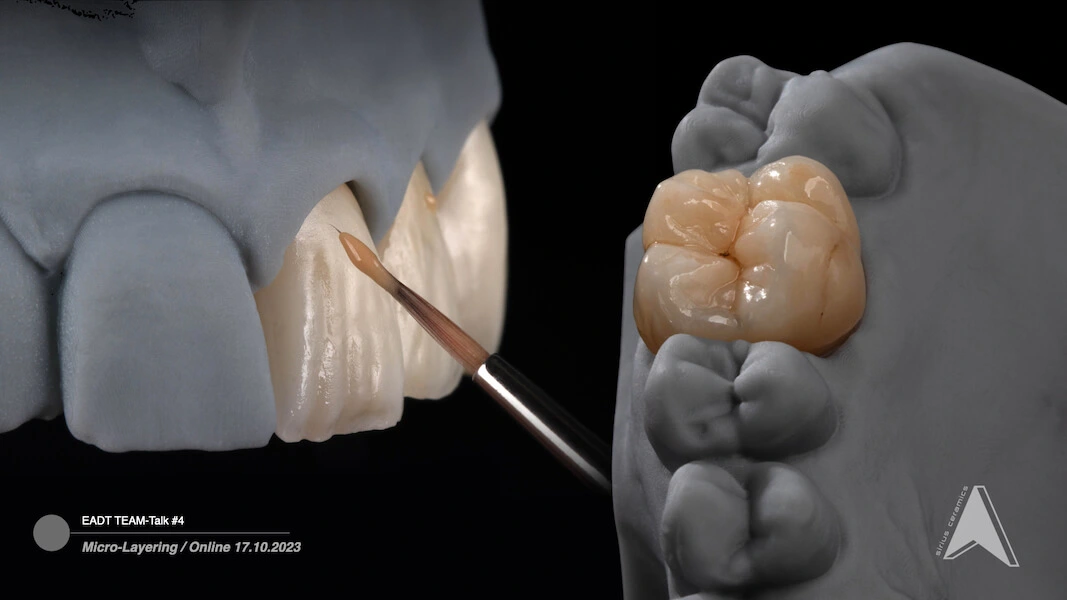
When experts from dental practices, dental laboratories, research and materials science, dental technology and the dental industry meet online, it can only be about one thing: the TEAM talk from EADT eV. The mix of different professions in the dental industry ensures a lively and multifaceted discussion. Over time, the TEAM Talk has established itself not only as a popular discussion format, but also as a dynamic working group. While many participants can describe themselves as “regulars” and don’t want to miss a TEAM talk, new faces are added with each new round.
The TEAM Talk #4 on October 18, 2023 marked another successful event in interdisciplinary exchange. The focus was on the topic of micro-layering”.
Micro-Layering: What's behind it?
Carsten Fischer opened the discussion with a presentation introducing the topic. This was followed by a moderated exchange among the participants. It quickly became clear that micro-layering is more than just a term. It is a widely used technique in dental laboratories for refining zirconia frameworks . Nevertheless, many questions remain about this relatively new method. The primary question is: What exactly is micro-layering? It became apparent that the complexity of the term encompasses both the process technology and the materials science , with particular emphasis on the special ceramics used to refine the zirconia framework. Different manufacturers use different terminology for this technology, including terms such as "3D pastes," "3D staining and layering ceramics," and "liquid ceramic." A key characteristic of this method is the use of a silicate-based veneering ceramic, which, due to its extremely fine particle size, is optimized for thin-layer veneering.
A central topic of the discussion was terminological clarity regarding micro-layering and the question of whether this is a thin-film veneer, a glaze or a coating of the dentin core framework. Micro-layering is currently often used as a buzzword, but there is currently no clear description for the all-ceramic finalization process. It became clear that a clear nomenclature for this relatively new approach is very important for a variety of reasons. In an initial discussion, the term “coating” emerged as the more appropriate term among the participants in the TEAM talk. In another TEAM talk, the topic will be discussed further and a clear procedure will be worked out together that could become generally applicable.
- The consensus was to define a layer thickness of 0,1 mm to 0,5 mm, which distinguishes this working technique from partial veneers and similar procedures.
Color differences: A critical point
Another point of discussion concerned the consistent color rendering of multi-layered zirconias. With such a thin layer thickness, color deviations, color offsets or visible gradations can hardly be compensated for by finalizing. It became clear that not all manufacturers perform equally when it comes to color. Since these are not 3D layered teeth, but linearly layered blanks, there are significant deviations from the established Vita color scale for all manufacturers, which potentially affects the color rendering and thus the result of the restoration. The need to be aware of these variations was emphasized and the creation of individual color samples from the multi-layered zirconias used in each laboratory was recommended.
Nesting was also discussed. The exact positioning of the restoration within the framework, particularly in relation to the vertical position, was identified as a crucial influencing factor for the shade quality of the framework. In order to achieve an optimal result, it is essential to adhere to precise specifications for the height positioning of the restoration in the blank.
Preparing the framework for micro-layering: software vs. manual grinding back
The topic of framework preparation was also discussed: When does the cut-back take place - directly in the software or by manually grinding the zirconium oxide framework? The majority of discussion participants leaned towards software-assisted preparation. The reasons: Software-based preparation offers greater efficiency and time savings. There are currently software applications in the established CAD design programs in which the “cut-back” option is possible. However, the framework is often reduced too much.
New to the market is dedicated cut-back software designed specifically for this step. It enables a targeted framework design that is precisely tailored to the subsequent veneering. The forecasts here are exciting. It is to be expected that software modules will be further optimized in the foreseeable future, for example through the use of artificial intelligence (AI). This automation could lead to the framework design for the coating being created largely automatically in the future based on individual specifications and experience.
TEAM Talk: A forum for everyone
The nice thing about TEAM Talk is the mix of participants. Their different backgrounds provide a wide variety of perspectives. Every contribution to the discussion, regardless of the area, is valued and included in the discussion. This creates a dynamic dialogue that is characterized by neutrality and objectivity and at the same time is relevant to practice and the laboratory. TEAM Talk #4 once again showed how important interdisciplinary exchange is. Not only was knowledge shared, but we also worked together on solutions to current challenges.
The TEAM Talk thrives, among other things, on the approach that those present actively participate. Within 60 minutes, the respective topic is examined from different perspectives. Due to the great interest, the many still open questions and the need to establish clear procedural paths, EADT eV has decided to give the topic of “Micro-Layering” the appropriate attention in another TEAM talk and to delve deeper into the subject .