

Manufacturing splints – additive, subtractive, or conventional? Which materials and manufacturing processes offer optimal results? A scientific torsion study provides clear answers for everyday practice and laboratory use.
Splints play a central role in the treatment of bruxism and craniomandibular dysfunction (CMD). The choice of the right material and manufacturing process—additive, subtractive, or conventional—is crucial for durability and therapeutic success. While conventional methods have been established for years, digital technologies such as 3D printing (additive) and CAD/CAM milling (subtractive) are opening up new possibilities in splint manufacturing. But which materials and processes are suitable for which clinical requirements? A recent torsion study provides practical answers.
Splints as a key element of therapy
Numerous patients exhibit clinical signs of tooth loss as a result of parafunctional activities such as teeth grinding and clenching. The severity of these symptoms ranges from simple bruxism with typical abrasion marks to more complex forms of craniomandibular dysfunction (CMD). The latter often manifests with key symptoms such as pain, restricted jaw opening, and temporomandibular joint noises.
Splints represent a central therapeutic measure in treatment. Depending on the clinical findings, different types of splints are used. These must not only withstand the intraoral forces but also specifically alleviate the prevailing symptoms. Accordingly, a wide variety of splint concepts exist, differentiated by indication, material composition, and manufacturing process.
Rails: materials and manufacturing processes
The literature contains numerous studies examining the mechanical properties of various splint materials. Among other things, a distinction is made between hard and soft splints—although the therapeutic benefits of soft splints, in particular, remain controversial.
In terms of manufacturing, conventional processes such as deep drawing and injection molding have been established over the years. With digitalization, additive (3D printing) and subtractive manufacturing processes (CAD/CAM milling) are now also available.
- Subtractive processes are based on milling from blocks of material, whereby a maximum of two rails can be manufactured simultaneously.
- Additive processes using 3D printing enable the simultaneous production of multiple rails.
This development has led to a significant expansion of the range of materials available – particularly in the area of soft and flexible materials for rails. But which materials offer the best mechanical properties for which application? To answer this question, it is important to examine the mechanical and physical properties of the materials.
material and methods
The study differed from previous studies in that it used a clinical splint geometry, rather than standardized test specimens. A total of 120 test specimens made of ten materials were examined:
- four additively manufactured splints (GR-10 guide [abbreviated as: aPG], ProArt Print Splint clear [aPP], V-Print Splint [aVS], V-Print Splint comfort [aVC]),
- five subtractively manufactured splints (BioniCut [bBC], EldyPlus [bEP], ProArt CAD Splint clear [bPC], Temp Premium Flexible [bTP], Thermeo [bTH]) and
- a conventionally manufactured splint (Pro Base Cold [cPB]) (Figure 1).
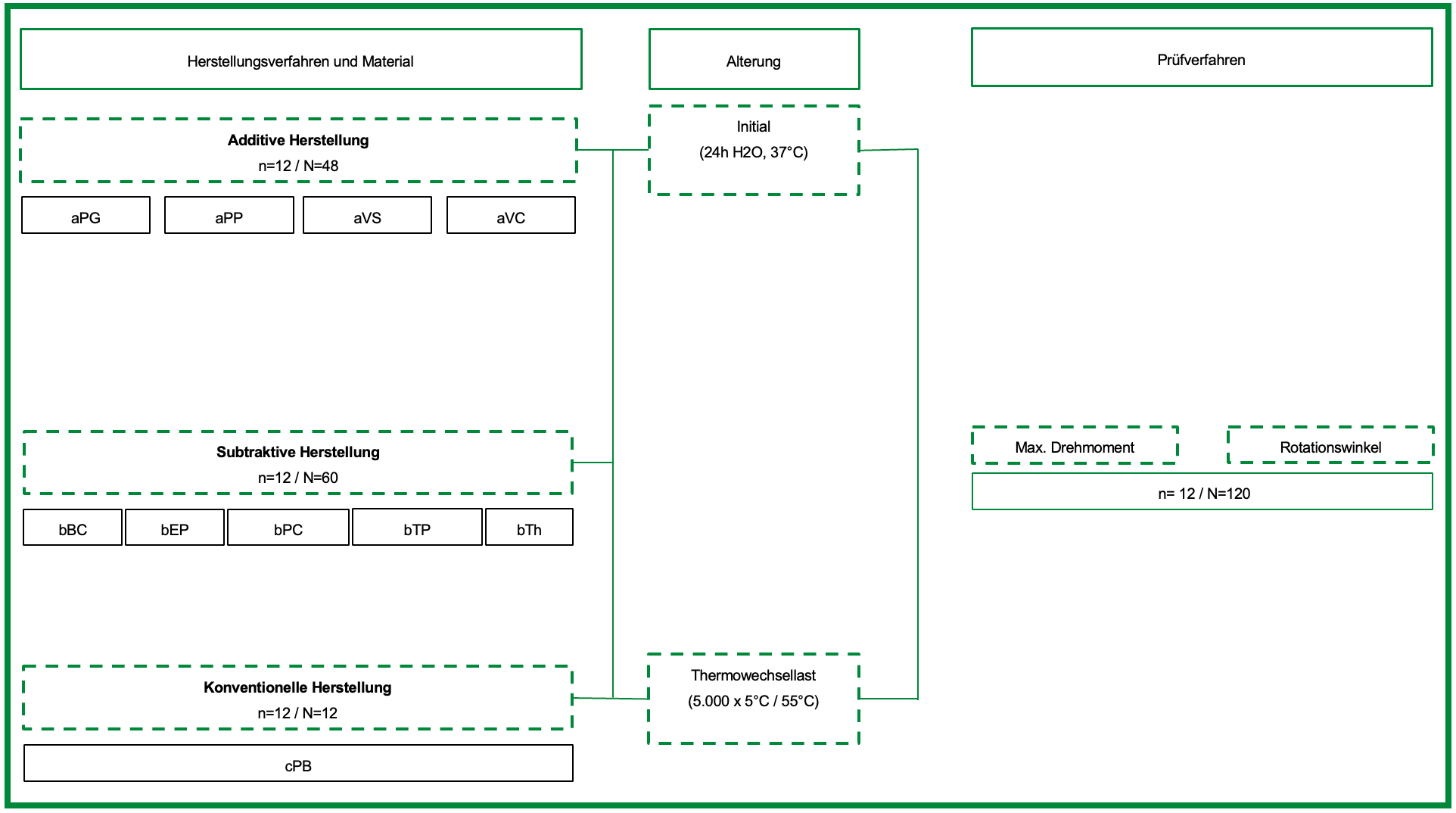
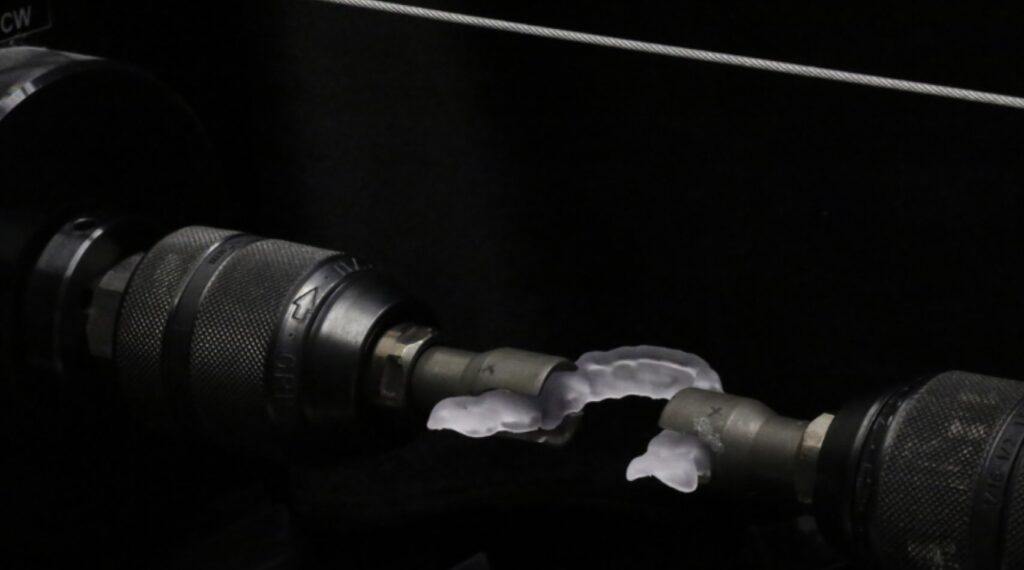
After 24 hours of immersion in water (37 °C) and thermal cycling (5000 cycles, 5/55 °C), the splints were fixed in a torsion testing machine, which rotated counterclockwise until either a crack or fracture occurred or the applied force decreased significantly (Figure 2). The distal end of the splint remained fixed in the fourth quadrant. The applied torque [TL], the rotation angle [AR], and the fracture behavior were determined.
The collected data were statistically analyzed using the Kolmogorov-Smirnov test, one-way ANOVA with a Scheffé post-hoc test, and a two-group t-test. The chi-square test and the Ciba-Geigy table were also used to analyze fracture type distribution. Statistical significance was assumed when p-values were < 0,05.
Results
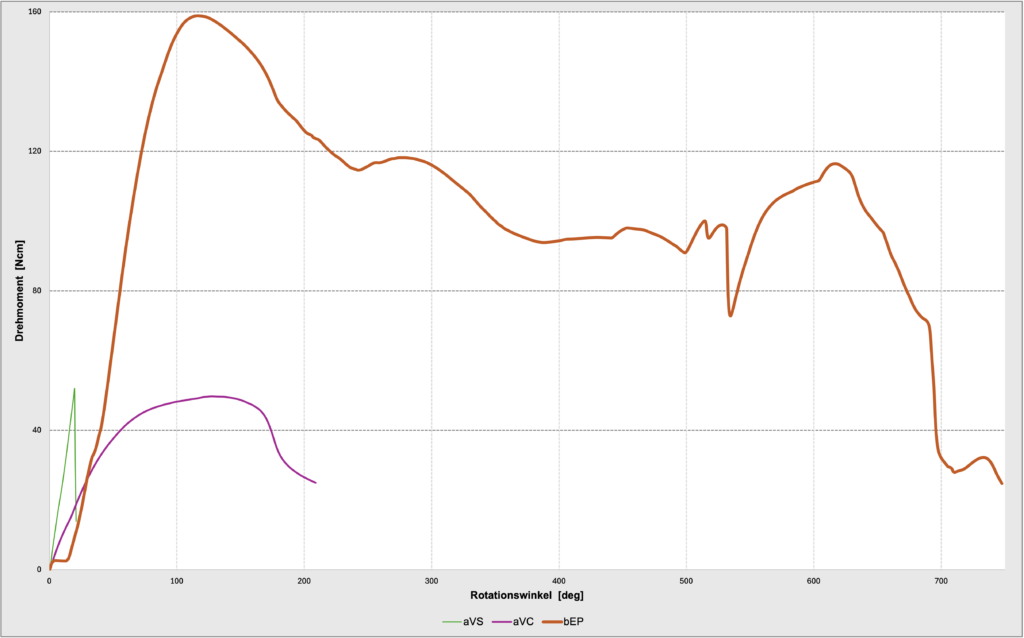
The evaluation of the results showed that the material composition had a stronger influence on torsional strength than the respective manufacturing process. Significant differences were observed within the subtractively manufactured group. After all aging tests, the milled polycarbonate exhibited the highest torque values, followed by the conventionally manufactured PMMA material and the remaining subtractively manufactured materials – with the exception of the milled Thermeo material. The lowest torque values were observed for the additively manufactured materials and the Thermeo material. No significant differences in torsional strength were observed between conventionally and subtractively manufactured PMMA-based materials.
Regarding the maximum rotation angle, the 3D-printed V-Print Splint comfort material and the subtractively manufactured materials Temp Premium Flexible, EldyPlus, and Thermeo showed the highest values. These materials were also the only ones that predominantly exhibited deformation and crack formation without complete fracture. In contrast, the milled and conventionally manufactured PMMA-based materials exhibited the smallest rotation angle. The different fracture behavior can be observed in the torque/rotation angle diagram (Figure 3).
Rails: Takeaways for manufacturing
- The material composition has a greater influence on torsional strength than the manufacturing process. The choice of material should therefore be a priority.
- Milled polycarbonate rails provide maximum stability, followed by rails made of conventionally manufactured PMMA materials. These are particularly suitable for applications where maximum stability is required.
- Flexible materials such as the 3D-printed V-Print Splint comfort and the milled materials Temp Premium Flexible, EldyPlus, and Thermeo deform rather than fracture. They exhibited the highest rotation angles.
- There are no significant differences in torsional strength between conventionally and subtractively manufactured PMMA-based splints. The decision between these procedures can therefore be made according to other criteria such as cost-effectiveness or availability.
Conclusion
The decisive factor for the therapeutic success of splints is not primarily the manufacturing process, but the selection of the right material according to clinical requirements. The choice of material should therefore always be tailored to the individual case in order to utilize the specific advantages of the different material classes.
The results of the study were in good agreement with the mechanical properties determined in previous studies using standardized test specimens. The chosen test setup thus provides important information about the flexibility of the splint materials investigated and their fracture behavior. In clinical practice, the selection of a suitable splint should be closely dependent on the specific material properties and the individual clinical situation.
examination
The results presented here are based on the following study: Maleki, T., Coldea, A., Meinen, J. et al. Torsional resistance of additively, subtractively, and conventionally manufactured occlusal devices. Clin Oral Invest 29, 286 (2025)