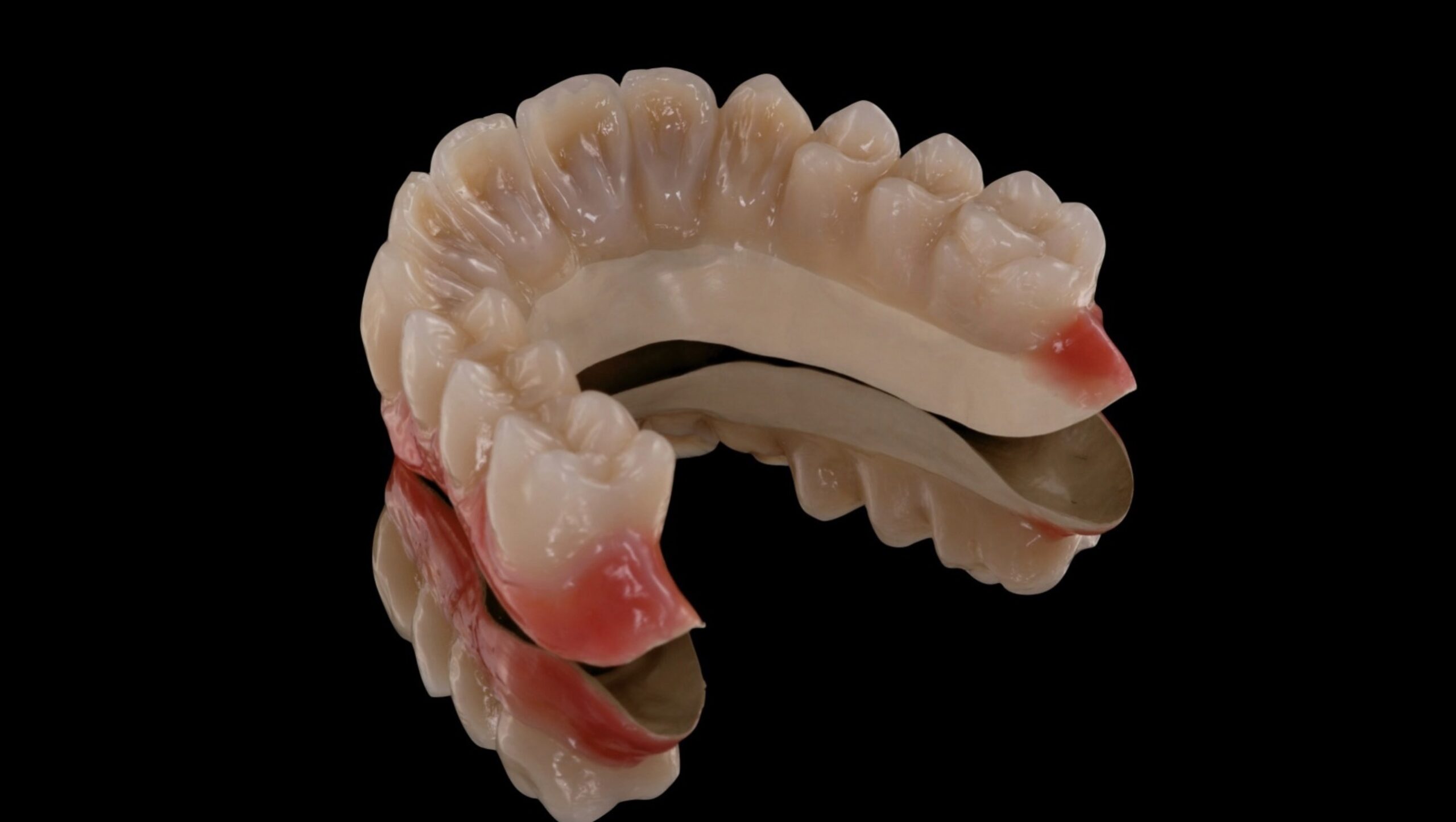
PAEK – high-performance dental polymers from the polyaryletherketone family – have become increasingly established in prosthetic applications in dentistry. They are used particularly for frameworks, e.g., for removable restorations. Can they now, with the addition of fillers, take the step towards monolithic restorations? (Cover image: Dental Technician Philipp von der Osten)
PAEK materials are used as framework materials for crowns, bridges, and dentures, as well as abutment materials for implants, due to their combination of thermal and chemical resistance, dimensional stability, and biocompatibility. Polyetheretherketone (PEEK), polyetherketoneketone (PEKK), and polyetherketone (PEK) are among the well-known materials and can exhibit increased stiffness or elasticity when combined. However, the transition to monolithic restorations is still hampered by their lack of aesthetics, mechanical properties, and abrasion resistance.
Inorganic fillers in PAEK materials
The integration of inorganic fillers can significantly improve these properties. Typical examples are silica, feldspar, or talc, with weight fractions of around 20 wt% showing promise. Closely related to this are particle size and distribution.
Fine particles < 1 µm enable a homogeneous matrix and good abrasion resistance. Larger particles increase strength and the modulus of elasticity. The bond between filler and matrix can be strengthened by silanization.
material and methods
In this study, 35 test specimens (40 wt% PEEK and 40 wt% PEK) with 5 different fillers (20 wt% pyrogenic silica, calcium silicate, feldspar, magnesium silicate hydrate), a control group without fillers, and commercial reference materials with ceramic fillers (BioHPP/PEEK20, BioHPP plus/PEEK25) were used as a comparison group. Different concentrations of calcium silicate (20, 25, 30 wt%) were investigated. The effect of silanization was examined with alkyl and aminosilanes for calcium silicate and with methyl and vinylsilanes for feldspar (Figure 1).

Results
Based on the results of these investigations, the compositions for three experimental PAEK composites were selected:
- PAEKi: 35% PEEK, 35% PEK, 30% calcium silicate (large particle size distribution)
- PAEKii: 70% PEEK, 30% calcium silicate (narrow particle distribution)
- PAEKiii: 70% PEEK, 25% calcium silicate, 5% feldspar (very fine particles, d50=1 µm)
BioHPP (PEEK20) with 20% ceramic filler (grain size 0,3–0,5 µm) served as the reference. Forty anatomical test specimens in the shape of a first mandibular molar were fabricated using these materials and examined in a chewing simulation with a total of 400.000 cycles (4 intervals of 100.000 cycles each).
Mechanical properties through variation of fillers
The mechanical properties of PAEK composites could be improved by adding fillers. Calcium silicate and magnesium silicate hydrate achieved the highest values for flexural strength and modulus of elasticity. With increasing filler content, especially up to 30 wt%, flexural strength, modulus of elasticity, and hardness (compared to 20 wt%) were all increased; the effect was most pronounced for the modulus of elasticity. Silanization with methylsilane resulted in the highest strength and stiffness values for feldspar-based materials, while for calcium silicate-based composites, treatment with aminosilane particularly increased hardness and flexural strength (Figure 2).

Abrasion resistance
The mechanical properties of the experimental materials, particularly PAEK i, showed significantly higher flexural strength (up to 210 MPa) and a higher modulus of elasticity (up to 8,4 GPa) than BioHPP (approx. 160 MPa; 3,9 GPa). The Shore D hardness ranged between 87 and 89 across all groups. In the chewing simulation, BioHPP proved to be the material with the highest abrasion resistance despite its lower strength: its lower modulus of elasticity acts as a damping factor, thus significantly reducing material loss under two-body loads. Differences in the filler composition of the experimental materials had little effect on wear resistance under the test conditions; rather, the particle size of the fillers and the homogeneity of the matrix were decisive (Figure 2).
Conclusion
The study demonstrates how targeted modifications—particularly the type and quantity of inorganic filler material and its chemical bonding via silanes—can improve the functional properties of PAEK composites, thus strengthening their use in monolithic dental prosthetics. While larger filler fractions primarily increase stiffness and hardness, smaller particles and a low modulus of elasticity show positive effects on wear resistance in two-body contact. Surface functionalization (e.g., aminosilanization) can optimize the bond within the polymer structure and provide higher mechanical strength. However, whether PAEK composites will establish themselves as a future material for monolithic restorations requires further investigation.
examination
The results presented here are summarized from the following study: Schmeiser F, Schramm W, Mayinger F, Baumert U, Stawarczyk B. Effect of Filler Type, Content, and Silanization on the Flexural Strength, Elastic Modulus, Shore D Hardness, and Two-Body Wear of PAEK Compounds. Materials (Basel). 2025;18(12):2736. Published 2025 Jun 11. doi:10.3390/ma18122736