
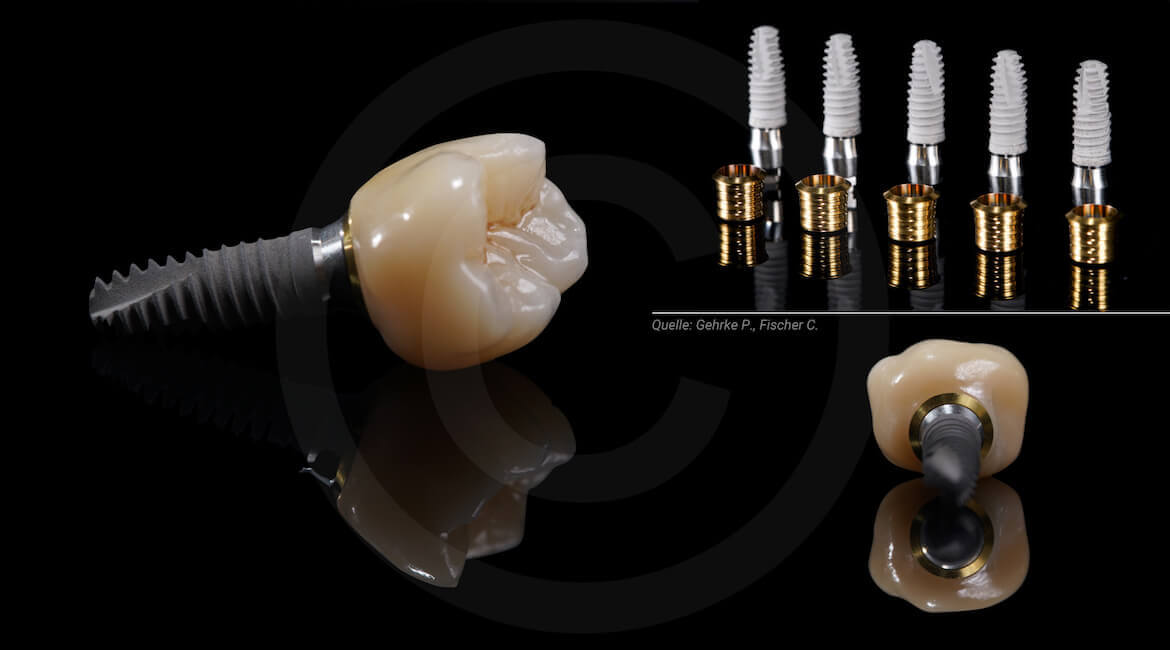
Conometric concept for implant-supported single crowns
A conometric concept allows a single crown to be fixed to the implant without cementing, bonding and screwing. The advantages mentioned are the avoidance of residues of fastening material and the elimination of additional retaining screws.
In an in vitro study, a team of researchers examined the fit and the risk of bacterial translocation at the junction between the abutment and the restoration. The results were published in the “International Journal of Molecular Sciences” [1].
Study group
Peter Gehrke, Philip Hartjen, Ralf Smeets, Martin Gosau, Ulrike Peters, Thomas Beikler, Carsten Fischer, Carolin Stolzer, Jürgen Geis-Gerstorfer, Paul Weigl, Sogand Schäfer
Briefly explained: The conometric concept for individual implant crowns
The conometric concept uses a cone-in-cone connection between the implant abutment and the crown for fixation [2]. The system consists of a conical cap that is cemented extraorally into an all-ceramic crown and then attached to the conical abutment ( Acuris Cap /Acuris Abutment, Dentsply Sirona Implants) by friction. Retention is achieved through the friction of the conical surfaces. The difference from previously known conometric connections is that the bonding between the cap and the ceramic crown can be performed extraorally by the dental technician.
The advantages of the econometric concept are mentioned
- cementless restoration; no risk of remaining fastening material,
- No additional retaining screws and therefore no screw channels,
- Support in the formation of the anatomical soft tissue profile,
- Use of cost-effective prefabricated components,
- easy care.
Bacterial translocation at the junction between abutment and restoration
In the study presented here [1], the research team looked at the fit and the risk of bacterial translocation at the connection between abutment and restoration. A misfit and a resulting microgap at the level of the restoration edges could serve as a bacterial reservoir that promotes plaque formation.
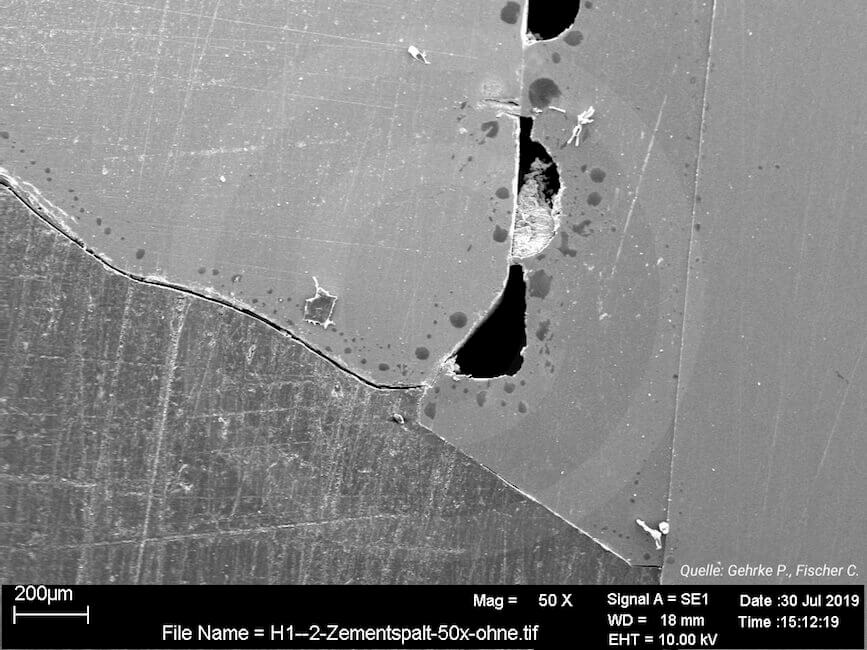
Scanning electron microscope (SEM) overview image of the ACURIS conometric cone fit and the crown cement gap at 50x magnification.
The investigation
The microbial tightness of the conometric-prosthetic connection was tested in a double variable study setup. The in vitro investigation did not reveal any bacterial transfer from or into the prosthetic connection. SEM analysis showed a marginal cement gap between the Acuris TiN cap and the ceramic crown within a clinically acceptable range of approximately 100 μm, but no microgap at the taper-in-taper Acuris junction. The holistic view of the bacterial colonization for the cone-in-cone coupling revealed no microbial leakage. The limitation of this study is that the influence of dynamic chewing loads on bacterial translocation was not investigated.
Further information on the investigation and practical application of the conometric concept:
[1] Gehrke P, Hartjen P, Smeets R, Gosau M, Peters U, Beikler T, Fischer C, Stolzer C, Geis-Gerstorfer J, Weigl P, Schäfer S. Marginal Adaptation and Microbial Leakage at Conometric Prosthetic Connections for Implant- Supported Single Crowns: An In Vitro Investigation. Int J Mol Sci. 2021 Jan 17;22(2):881
[2] Gehrke P, Fischer C., Weinhold O., Dhom G. The conometric concept for implant-supported single crowns: definitive fixation without cement or screws. ZWR – The German Dental Journal 2021; 130: 1–7