
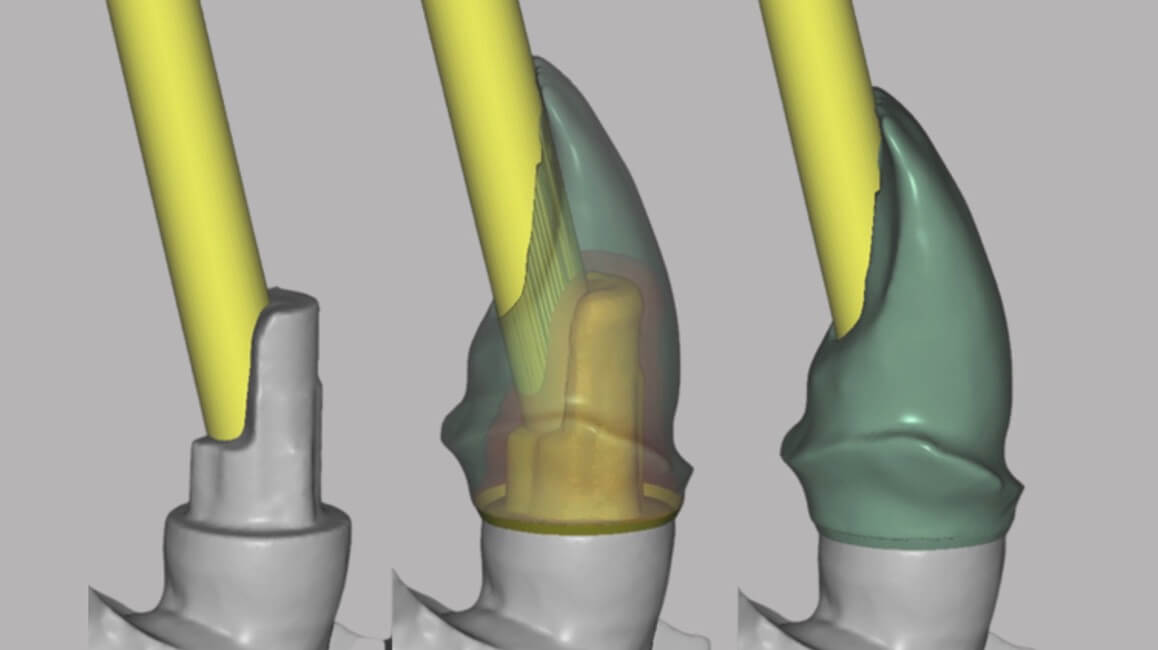
In implant prosthetics, occlusal screw-retained restorations can reach functional and aesthetic limits, for example if screw channel openings are in buccal surfaces or between the teeth. In edentulous fixed implant restorations, openings of screw channels can also occur in areas of the reconstructed gingiva.
Andreas Kunz, Dr. Insa Herklotz
In parts 1 and 2 of our series on implant prosthetics, we discussed in detail the decision-making factors for screw-retained and cemented implant-supported fixed restorations. A key point regarding occlusally screw-retained restorations was the importance of an ideally positioned implant axis to optimize the emergence point of the occlusal screw on the tooth surface. The optimal position of the screw emergence point is located centrally in posterior teeth and palatally in anterior teeth (Fig. 1). Angulating the screw channel – independent of the implant axis – allows for new variations in screw-retained restorations (Fig. 2). Angled screw channels offer flexible treatment options for the best possible aesthetic and functional results.
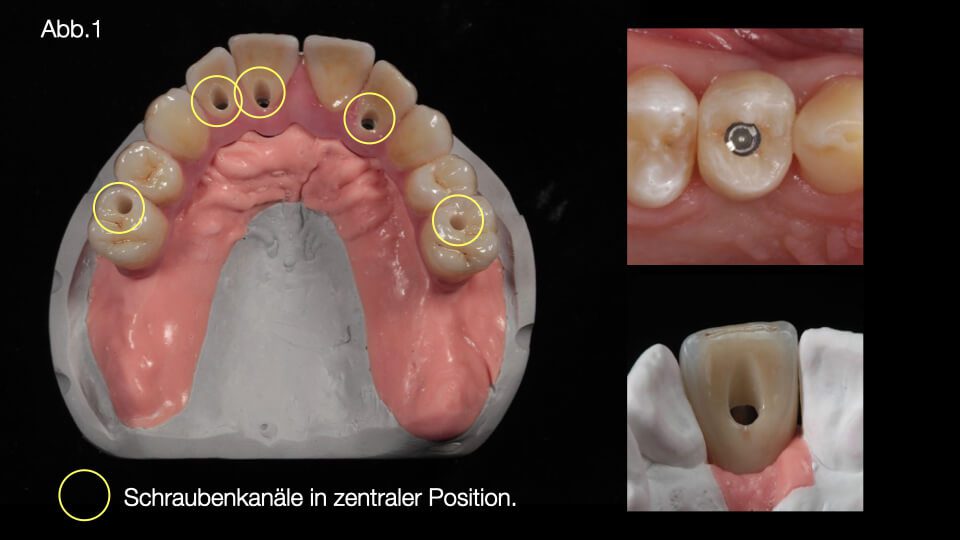
Fig.1: Occlusal openings of implant screws should not be in functionally and aesthetically relevant areas. To avoid fractures of the ceramic, it is important to ensure sufficient material strength around the screw channel.
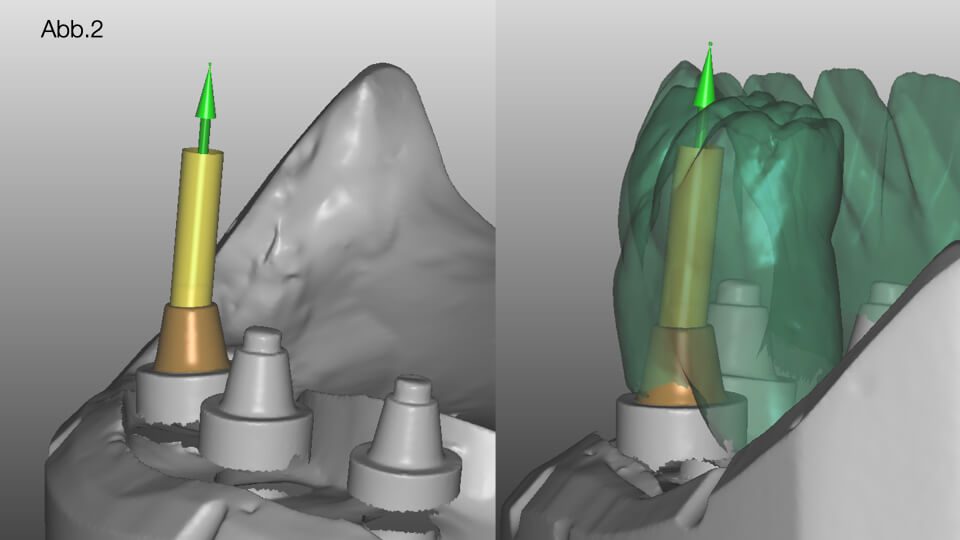
Fig. 2: By changing the angle (angular bend) between the implant axis and the screw channel, angulated screw channels (ASC) can be created.
Implant prosthetics and angled screw channels
Angled screw channels should not be confused with angled/angled abutments. Different names for system components from individual implant system providers can often be confusing. Angled or angled abutments have an angled portion. The screw channel is at the same angle with the implant axis. Another variant are angled bridges or web structures, generally also described as intermediate structures. This angled structure is currently often used for restorations according to the MALO CLINIC® protocol. The abutment consists of an angled (often 17° or 30°) structure (abutment) onto which another abutment can be screwed (Fig. 3).
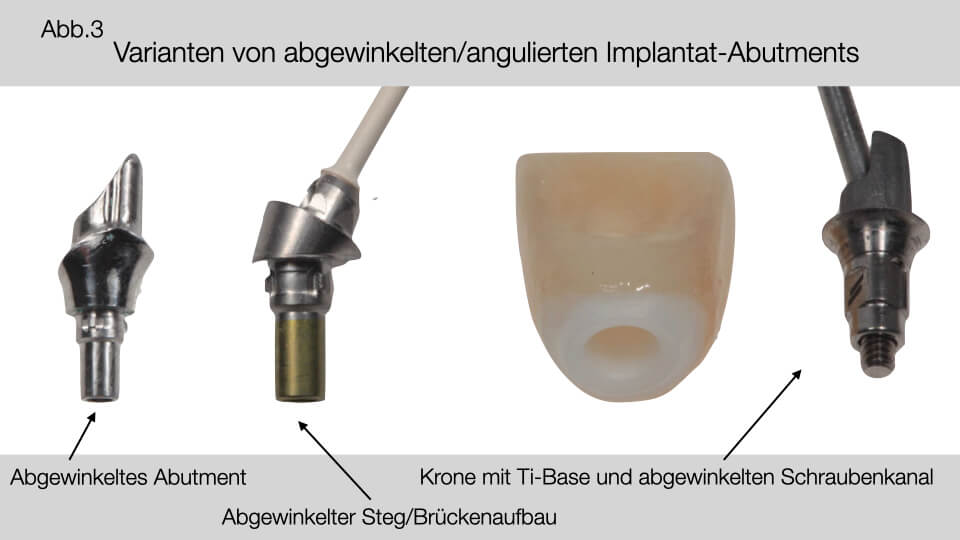
Fig. 3: Variations of angled abutments (from left to right): angled abutment, angled bar/bridge structure (often called abutment), titanium base for angled screw channel with crown.
For abutments or crowns and bridges with angulated screw channels, the degree of angulation of the screw channel varies depending on the implant system. The angulation between the screw channel and the implant axis creates an angular bend. The basic requirement for angulation is a special screw and a screwdriver intended for this purpose (Fig. 4). Screw heads and screwdrivers with ball heads must have special freedom for the angle of angulation in order to ensure reliable power transmission of the required insertion torque (Fig. 5). In addition to the screw and screwdriver, the abutment (e.g. titanium adhesive base) must have a special recess to adjust the angle of the screwdriver (Figs. 6 and 7). Numerous implant manufacturers offer solutions with different angulations for different implant systems.
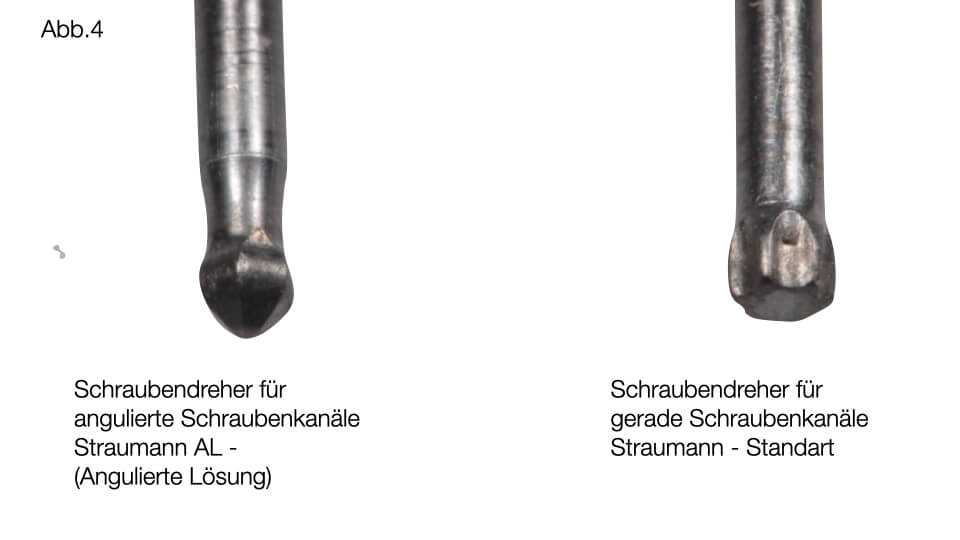
Fig. 4: Comparison of screwdrivers for angled or straight (standard) screw channels.
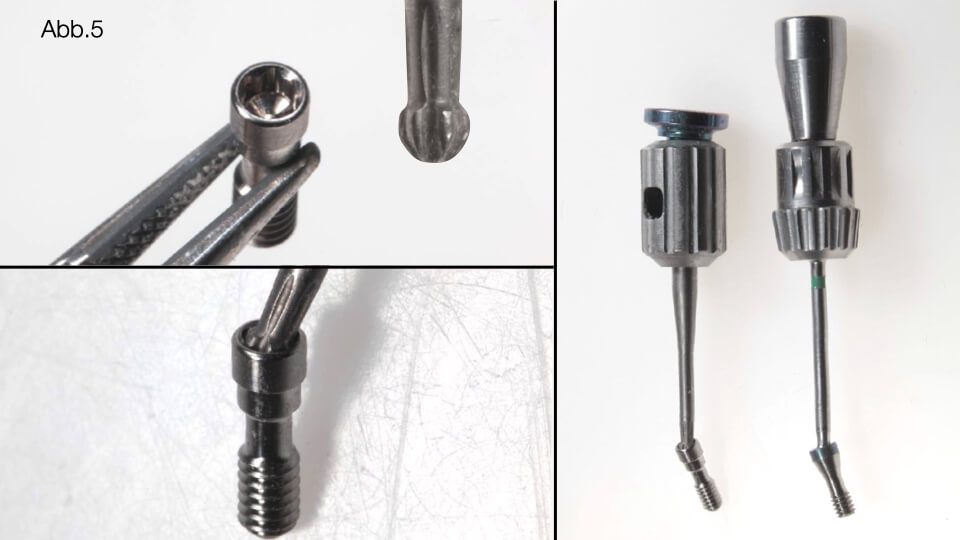
Fig. 5: The screw head and ball head of the screwdriver must be matched to one another. The screw has an inwardly lowered edge, which is important for the degrees of freedom of the ball head (screwdriver). The illustration on the right shows angled system components from different providers.
Examples of a selection of angled screw channel solutions:
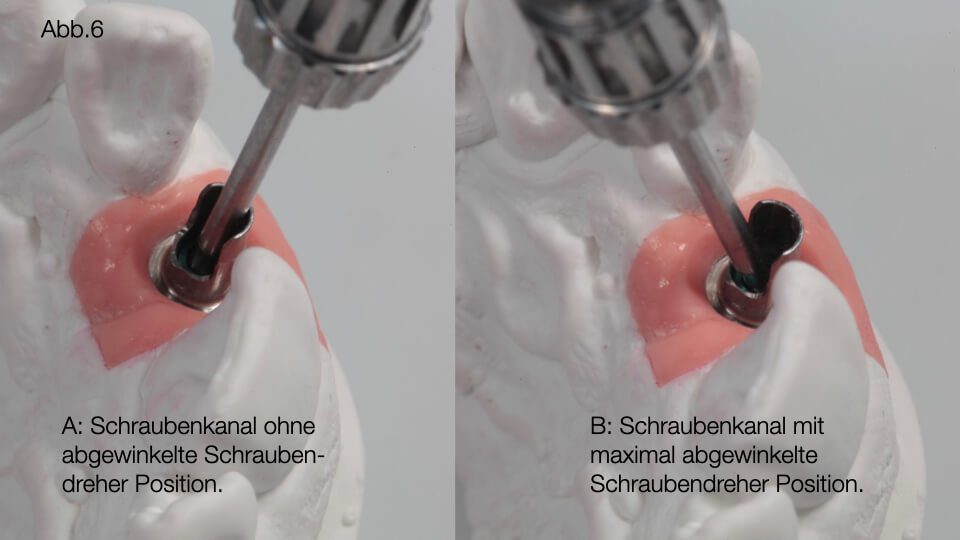
Fig. 6: The angle between the implant axis and the angled screwdriver position can be varied.
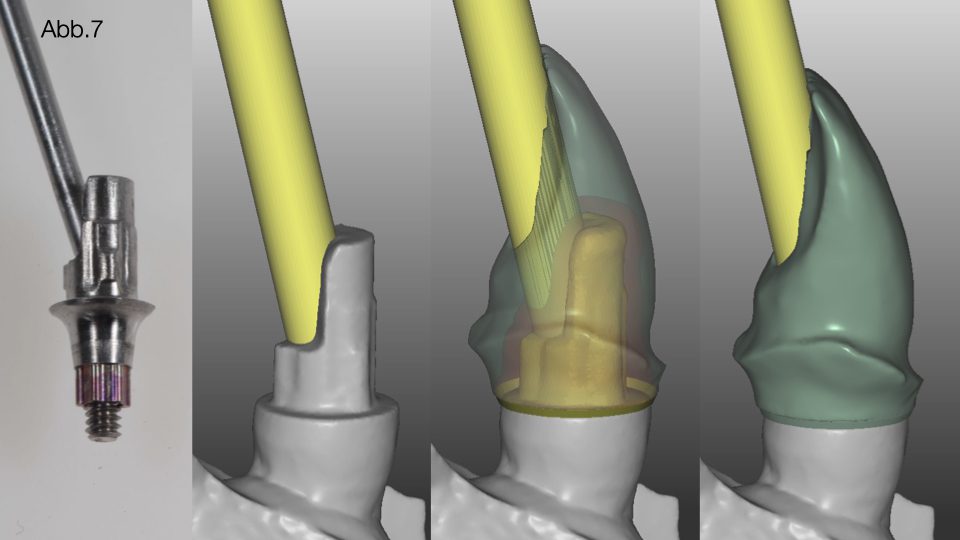
Fig. 7: The bend between the implant axis (screw axis) and the screw channel often does not allow the screw to be inserted after bonding. The ability to insert the screw depends on the strength of the angle bend and on the diameter of the screw in relation to the canal diameter.
Angulated screw channels (implant prosthetics) in the literature
The first articles about angled screw channels can be found in the literature (Pubmed) from 2012 (Park et al, Laudensack et al, Gjelvold et al) [1, 2, 3]. As already stated, the advantages of angling the screw channel are obvious. Anitua et al and Friberg et al found no statistical difference in implant loss or implant bone loss between angled and straight screw channels [4, 5]. An important topic in the current literature is the force transmission of the screwdriver to the screw head in relation to the torque of the implant system. Hu et al showed the influence of force transmission of the insertion torque on the screw at different angulations of screw channels at 0°, 10° and 20° [6]. In a study of different abutment systems with different screw channel angulation, Swamidass et al showed no significant difference between the 0° and 20° groups of an implant system. However, torque differences were found in implant systems with lower insertion torques [7]. In a comparative study by Opler et al, the influence of screw angulation was shown in relation to the torque loss of angled (ASC=Angulated Screw Channel) and straight (SCR=Screw Retained Crowns) screw channels. This showed influence in terms of the torque of the screw head at 0° to 15° showed no significant difference. However, decreased torque was noted at screw angulation of 25° and 28°.
Practical application of angled screw channels in implant prosthetics
The various studies show how important it is to use the manufacturer-validated screw head screwdrivers with appropriate abutments. If screw channels are angled without special systems, the power transmission between the screw head and the screwdriver cannot be optimally guaranteed. The exit point of the screw opening should be designed palatally in the anterior tooth area with sufficient distance (> 1 mm) to the incisal edge. In the posterior tooth area, the screw opening should be placed centrally in the chewing surface. The lower the angulation of the screw channel, the better the force transmission from the screwdriver to the screw head (Fig. 8 and 9). If the screw channel is strongly angled, the original screw must be inserted before bonding to the Ti base. The kink between the implant axis (screw axis) and the screw channel often does not allow the screw to be inserted after bonding. The possibility of inserting the screw depends on the one hand on the angular bend and on the other hand on the diameter of the screw in relation to the canal diameter. Unfortunately, not all implant systems yet offer special components for the angulation of screw channels. This restriction is a prosthetic limitation when it comes to the optimal positioning of occlusal screw openings.
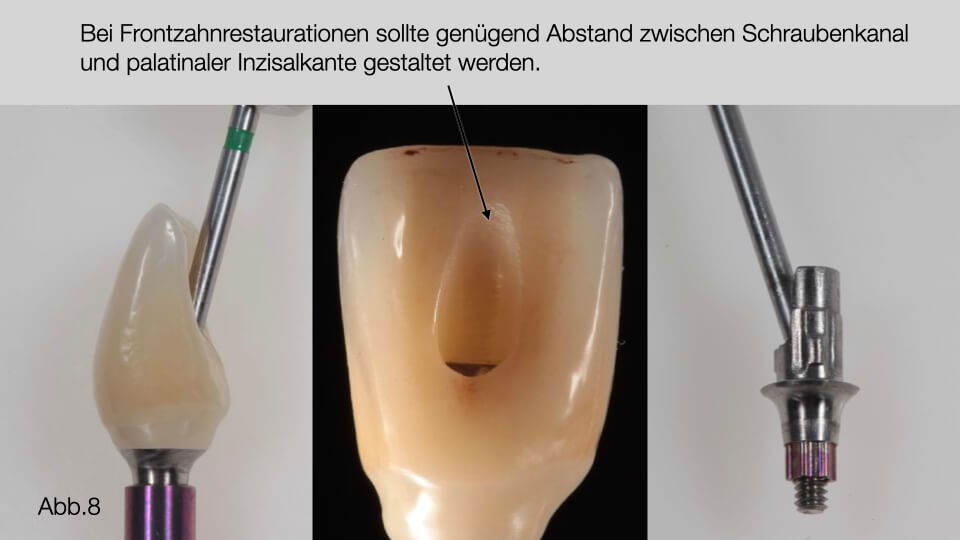
Fig. 8: If the screw channel is strongly angled, the original screw must be inserted before bonding to the Ti base. The screw channel must be circular and made of framework material (for all-ceramic: lithium silicate or zirconium oxide).
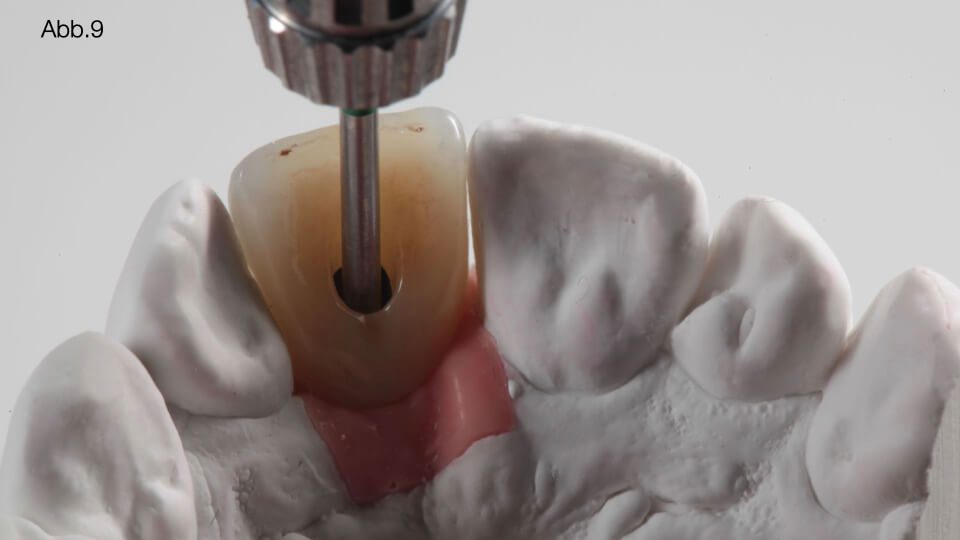
Fig. 9: Invisible... an angled screw channel is often difficult to see after fabrication. Teamwork is required here to ensure that the wrong screwdriver is not used when inserting the prosthetic restoration.
Read Implant Prosthetics (Part 2):
Literature:
[1] Park JI, Yoon TH. A three-dimensional image-superimposition CAD/CAM technique to record the position and angulation of the implant abutment screw access channel. J Prosthet Dent. 2013 Jan;109(1):57-60
[2] Lautensack J, Weber V, Wolfart S. Template to determine the position and angulation of the abutment screw channel for implant-supported, cement-retained restorations. J Prosthet Dent. 2012 Feb;107(2):134-6
[3] Gjelvold B, Sohrabi MM, Chrcanovic BR. Angled Screw Channel: An Alternative to Cemented Single-Implant Restorations–Three Clinical Examples. Int J Prosthodont. 2016 Jan-Feb;29(1):74-6
[4] Anitua E, Fernández-de-Retana S, Alkhraisat MH. Survival and Marginal Bone Loss of Dental Implants Supporting Cad-Cam Angled Channel Restorations: A Split-Mouth Retrospective Study. Your J Dent. 2020 Mar;14(2):194-199. doi: 10.1055/s-0040-1709895. Epub 2020 May 24.
[5] Friberg B, Ahmadzai M. A prospective study on single tooth reconstructions using parallel walled implants with internal connection (NobelParallel CC) and abutments with angulated screw channels (ASC). Clin Implant Dent Relat Res. 2019 Apr;21(2):226-231.
[6] Hu E, Petrich A, Imamura G, Hamlin C. Effect of Screw Channel Angulation on Reverse Torque Values of Dental Implant Abutment Screws. J Prosthodont. 2019 Dec;28(9):969-972
[7] Swamidass RS, Kan JYK, Kattadiyil MT, Goodacre CJ, Lozada J. Abutment screw torque changes with straight and angled screw-access channels. J Prosthet Dent. 2021 Apr;125(4):675-681
[8] Opler R, Wadhwani C, Chung KH. The effect of screwdriver angle variation on the off-axis implant abutment system and hexalobular screw. J Prosthet Dent. 2020 Mar;123(3):524-528.