

Is corundum blasting a safe alternative to hydrofluoric acid etching of feldspathic ceramics prior to intraoral cementation? This article summarizes a study comparing the fracture load of feldspathic ceramic crowns after both pretreatments (corundum blasting vs. etching).
The fabrication and cementation of feldspathic ceramic restorations follows a material-specific procedure [1]. After subtractive fabrication, the outer surfaces of the restorations are polished using handpieces and suitable burs and polishers. Before intraoral cementation to the prepared tooth, the inner surface of the restoration must have sufficient roughness to achieve the necessary bond strength with the luting composite. The standard method for roughening feldspathic ceramic restorations is extraoral etching with hydrofluoric acid (HF) gels at concentrations of 4,9%–10%. This preferentially dissolves the glassy matrix, exposes crystalline structures, and creates microporosities for the infiltration of the luting cement [2]. The HF gel is typically applied to the restoration surface for 60 seconds and then rinsed off. Despite the dilution, however, HF gels are highly aggressive and can cause skin and eye burns in dentists and patients. Furthermore, unnoticed drops of HF gel can etch ceramic surfaces, which is why extreme caution is required during the etching process.
A potential alternative to roughening feldspathic ceramic restorations is particle abrasion with aluminum oxide (Al₂O₃), also known as corundum blasting. However, overly aggressive particle abrasion may potentially reduce the resilience of the restorations during clinical use.
material and methods
After the subtractive fabrication (Ceramill Motion 2, Amann Girrbach) of feldspar ceramic restorations, the inner surfaces of crowns (Mark II, Vita Zahnfabrik) were either
- Corundum blasted (Keramo 4, Renfert; 25 µm Al₂O₃ particles; air pressure 0,1 MPa)
- or etched (Ultradent Porcelain Etch, Ultradent; HF, 60 s)
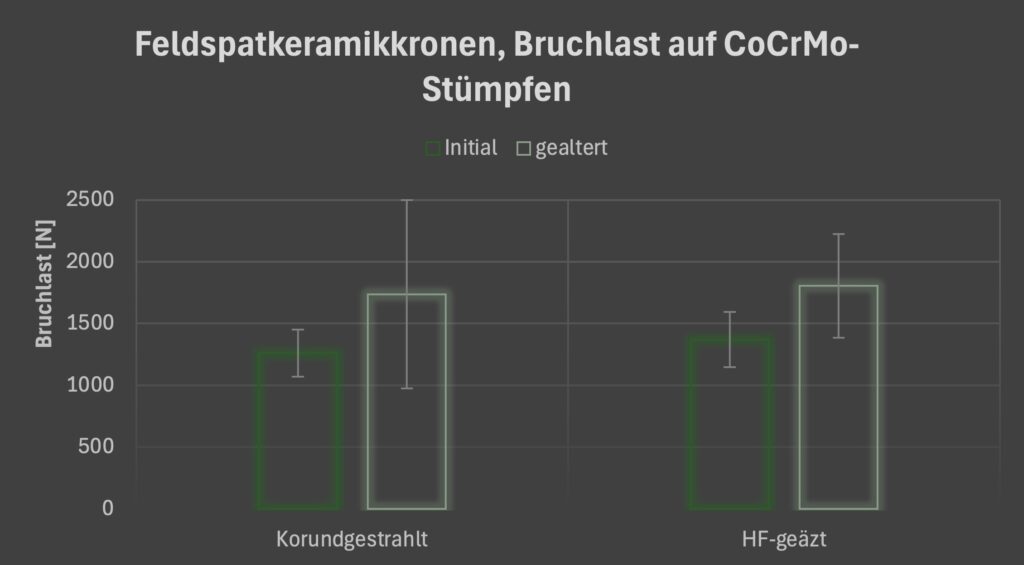
and subsequently cemented to CoCrMo and polymer dies using RelyX Unicem Automix (3M). Additionally, a chewing simulation (1,2 million cycles) was used as an artificial aging protocol to replicate the wear of the restorations in vitro. The fracture load of the crowns was measured for both unaged and aged specimens (Fig. 1).

Results
- For crowns cemented on CoCrMo dies, aging influenced the fracture load, but not the pretreatment method (Fig. 2).
- For crowns cemented to polymer abutments, pretreatment had an impact on the fracture load of initially measured specimens. These crowns showed no aging effects (Fig. 3).
- Within the limitations of this in vitro study, it can be concluded that roughening of the inner surfaces of feldspar ceramic crowns by corundum blasting with 25 µm Al₂O₃ at 0,1 MPa air pressure does not negatively affect the fracture load and is comparable to hydrofluoric acid etching.
- Corundum blasting could be an alternative method for treating the inner surfaces of feldspar ceramic crowns before cementation.

Conclusion
The study shows that corundum blasting (25 µm Al₂O₃, 0,1 MPa) could be a safe alternative to etching feldspar ceramic inner surfaces prior to intraoral cementation without compromising the fracture load of the crowns. This potentially means greater safety for practice teams and patients.
examination
Detailed results, analyses, and evaluations can be found in the following study: Coldea A, Stawarczyk B, Meinen J, Lankes V, Swain MV, Roos M. Fracture load of feldspar ceramic crowns: effects of surface treatments and aging. Clin Oral Investig. 2025, 29:51.
further reading
Federlin M, Hiller KA, Schmalz G (2014)
Effect of selective enamel etching on clinical performance of CAD/CAM partial ceramic crowns luted with a self-adhesive resin cement. Clin Oral Investig 18:1975-84.
Stawarczyk B, Hristova E, Sener B, Roos M, Edelhoff D, Keul C (2014)
Effect of Hydrofluoric Acid Etching Duration on Fracture Load and Surface Properties of Three CAD/CAM Glass-Ceramics. Oral Health Dent Manag 13:742-751. link