
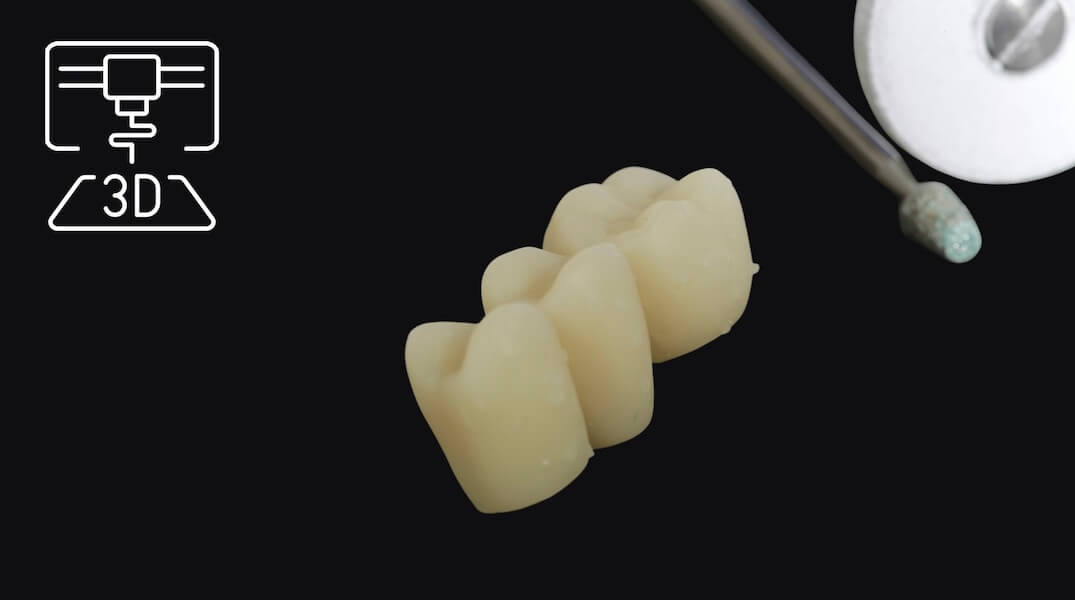
Dental 3D printing… the ongoing innovations in additive manufacturing are opening up more and more clinical applications in dentistry. 3D printing technology now promises aesthetic, tooth-colored restorations that can be produced quickly and with minimal material usage.
Valerie Lankes, LUM Munich
Dental 3D printing: Fixing printed long-term temporary restorations
Nowadays, the additive manufacturing of long-term temporary restorations increasingly offers an alternative to the conventional process thanks to improved material properties. However, for the successful clinical use of fixed 3D printed restorations, their intraoral fixation is a crucial factor. The low residual monomer content, the high conversion rate and the highly cross-linked density of carbon compounds can pose a challenge for bonding to adhesive luting materials.
In vitro investigation: cleaning method and mechanical pretreatment
The aim of this in vitro study was to investigate whether the cleaning method and the mechanical pretreatment of the adhesive surface influence the bond strength to a conventional luting composite. The effects of thermo-mechanical aging and the test method used (shear or tensile test) were also examined.

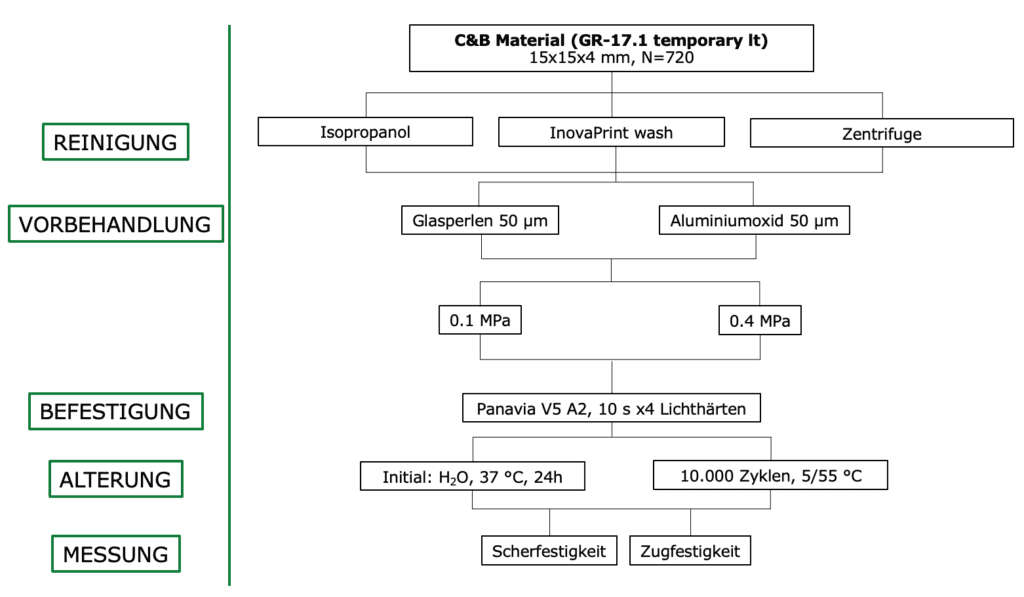
Fig. 1 Study design
material and methods
900 test specimens (printodent GR-17.1 temporary lt, Pro3dure medical GmbH, Iserlohn) were produced additively. 300 of the printed test specimens were chemically cleaned using isopropanol [ISO] (100%, SAP LP) or a solution containing butyl diglycol [BUT] (InovaPrint wash, HPdent GmbH) or by centrifuging [CEN] (Fig. 2) to remove excess Monomer freed. The mechanical pretreatment was then carried out using blasting media (average grain size 50 µm), aluminum oxide (blasting corundum, Orbis) or glass beads (Perlablast micro, Bego). The test specimens were blasted for 10 s at 0.1 MPa or 0.4 MPa each (Fig. 3). The control group was blasted with aluminum oxide (0.1 MPa) and additionally conditioned with visio.link (bredent GmbH). A conventional luting composite (Panavia V5, Kuraray Noritake) with a defined adhesive surface was then attached to the pretreated surfaces using prefabricated sleeves (Fig. 4).

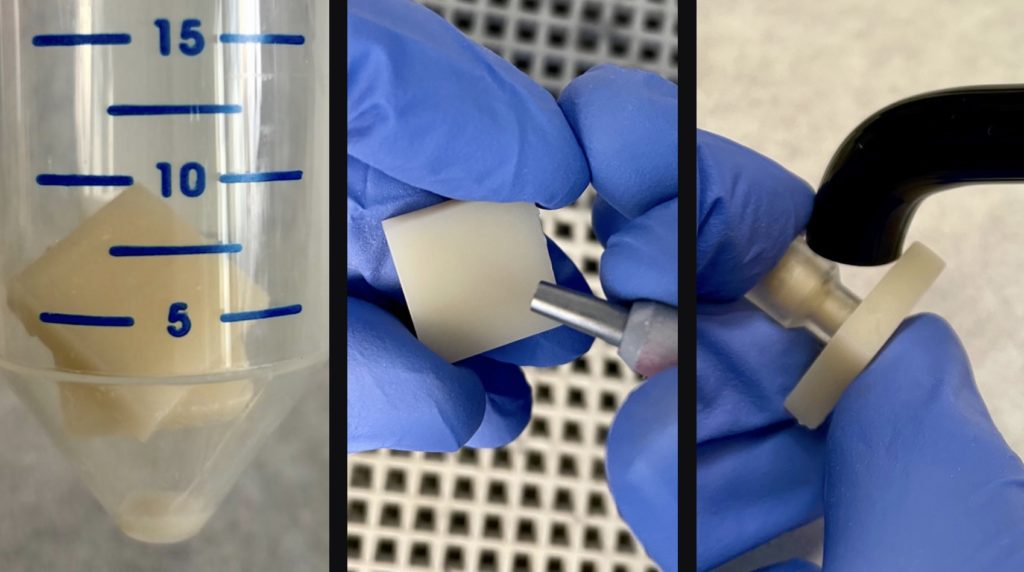
Fig. 2 to 4: Test specimen after centrifugation with excess resin. Corundum blasted 3D printed test specimen. Test specimen (bottom) connected to the luting composite (sleeve) and polymerization lamp
Half of the test specimens were subjected to artificial aging in a thermal load changer (10 cycles, 000/5°C). The bond strength (MPa) [= breaking load (N) / adhesive area (mm55)] was then determined in shear or tensile tests.
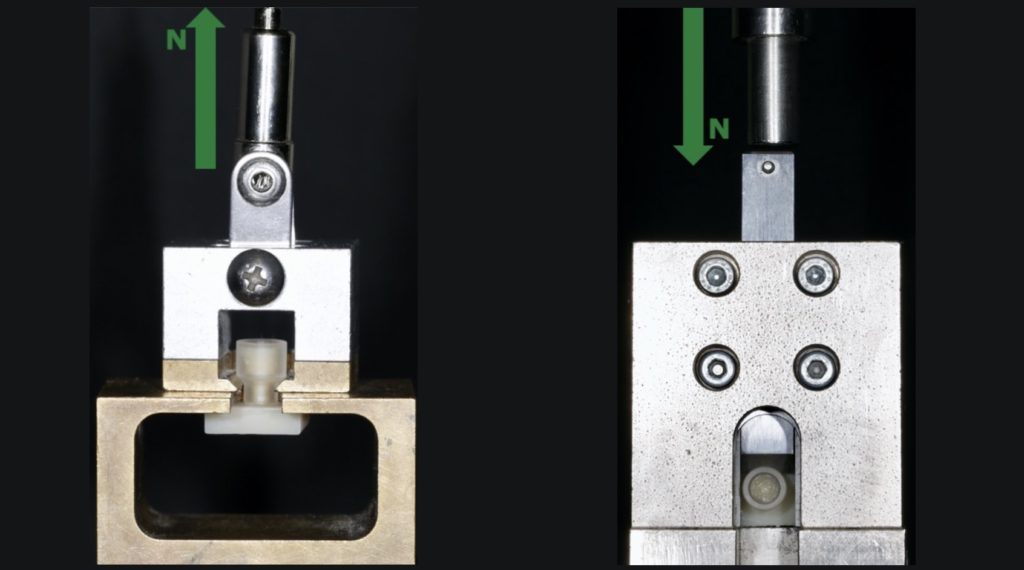
Fig. 6 and 7 Test specimens in the tensile test with force direction N and test specimens in the shear test with force direction N
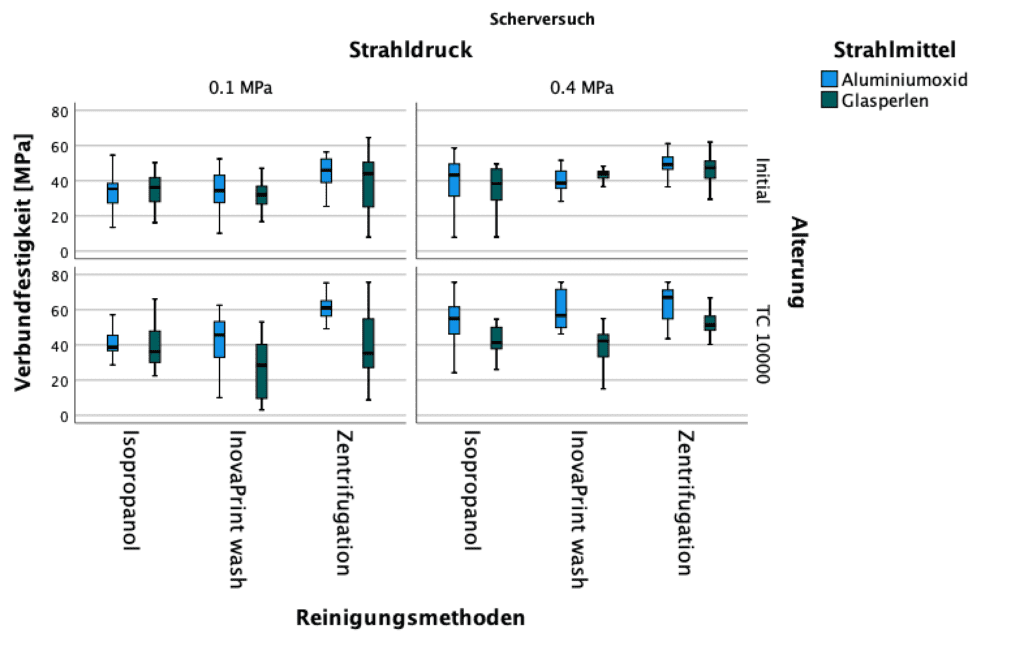
Fig. 5 Boxplot: shear strength
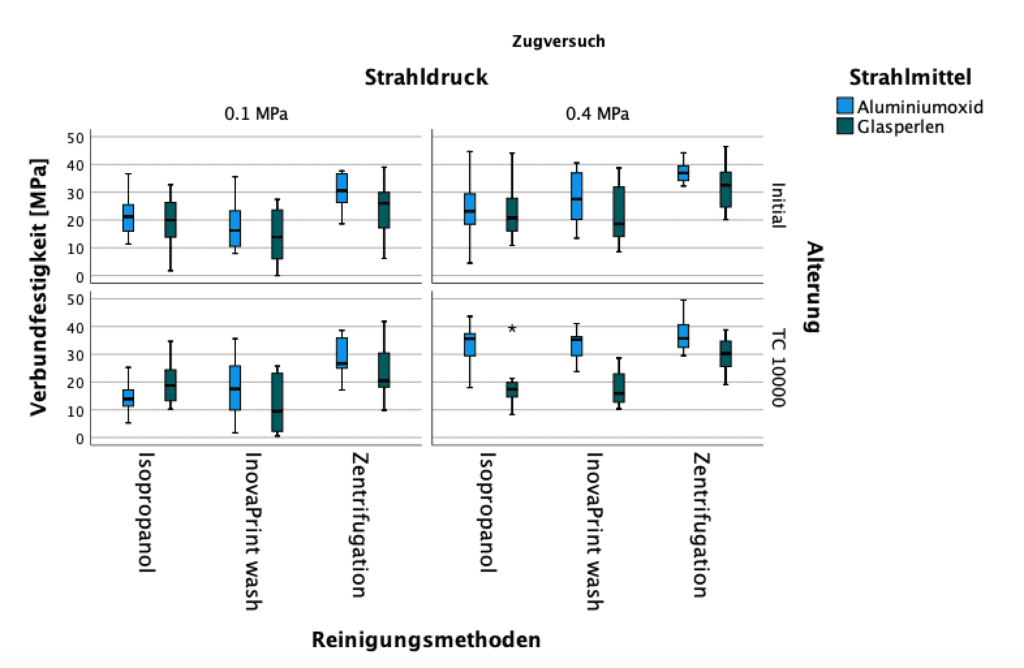
Fig.6 Boxplot: tensile strength
Results
The test method (shear or tensile test) had the greatest effect on the bond strength. Higher values were achieved for the shear strength than for the tensile strength. A correlation between shear and tensile strength was observed. The cleaning method also influenced the bond strength. Centrifugation increased the bond to the luting composite compared to chemical cleaning. The pretreatment with glass beads at 0.1 MPa showed the lowest bond strengths, aluminum oxide at 0.4 MPa the highest. The control group achieved bond strengths as high as aluminum oxide (0.4 MPa). Artificial aging tended to have a positive influence on the bond strength.
Conclusion
The results of this study show that the cleaning method and mechanical pretreatment of the bonding surface influence the bond strength of 3D printed resins to a conventional luting composite. With regard to a fastening strategy, blasting with aluminum oxide at 0.4 MPa or additional conditioning with visio.link achieved the highest bond strengths, regardless of the chemical or mechanical cleaning method.