
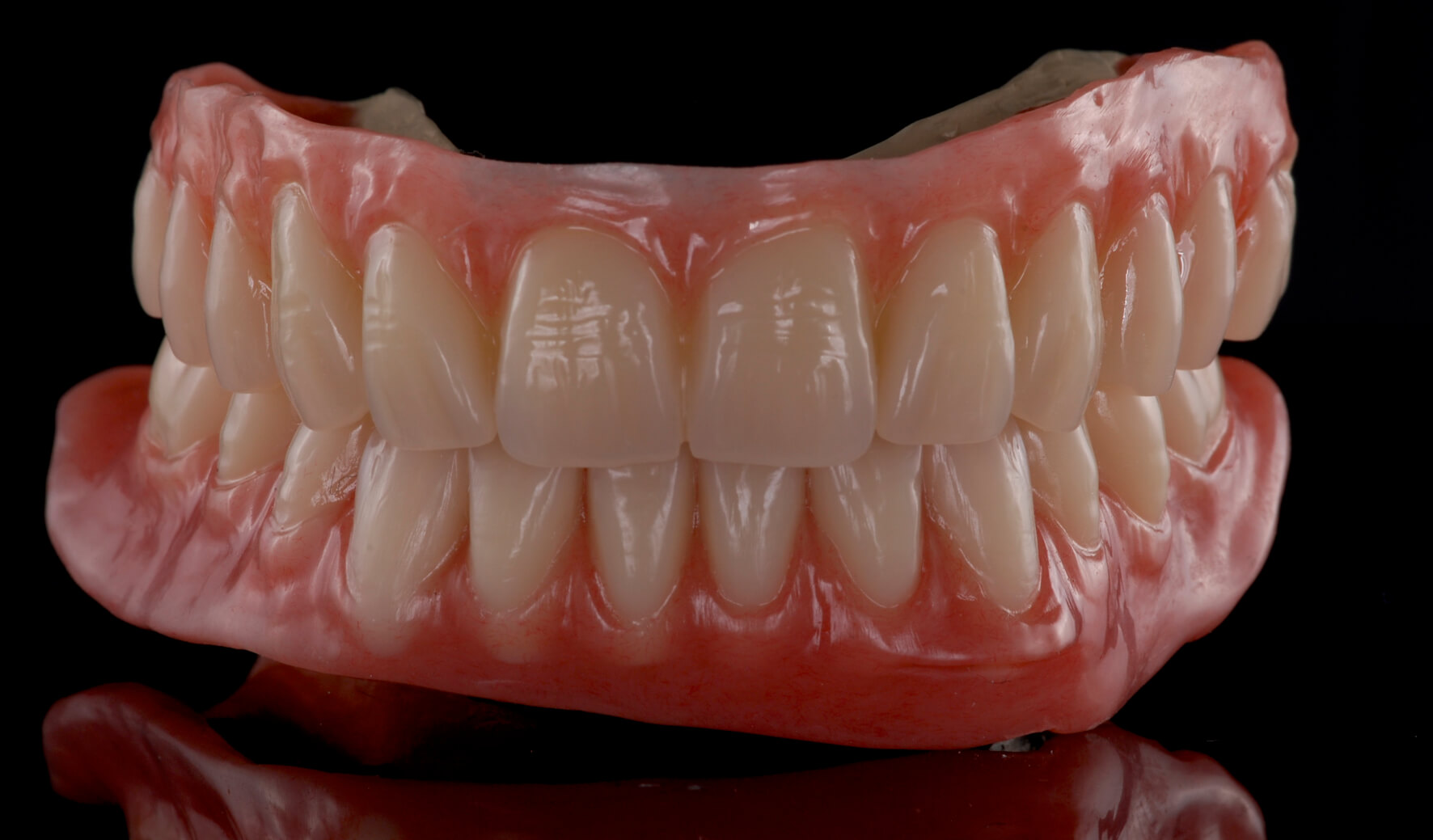
Effects of the test specimen geometry, the antagonist materials and the test setup
Authors: Anja Liebermann, Annett Kieschnick, Bogna Stawarczyk
PEEK, CAD/CAM composites and CAD/CAM-PMMA are increasingly being used in digital dentistry. But how do the materials behave in the mouth in the long term? In the study presented here, these materials were tested with regard to various aspects.
Several studies tested the performance of CAD/CAM plastic restorations in terms of their color stability and mechanical properties [1-4]. Comparable or even better results have been achieved than with glass ceramics [1-4]. A major advantage of plastics over ceramics is the lower modulus of elasticity, which enables functional loads to be dampened [4]. Another advantage is the higher abrasion resistance compared to the enamel antagonist [4, 5, 6].
Currently, polyetheretherketone (PEEK) – a polymer from the PAEK (polyaryletherketone) group – is also a focus among plastics . PEEK is available as an industrially manufactured blank/block for CAD/CAM fabrication or as pellets or granules for compression molding. Due to its excellent physical and biological properties, PEEK has gained widespread acceptance in medicine and has been proposed as a potential material for definitive dental prostheses [7, 8]. Regarding the bonding of PEEK with other dental plastics, the initial difficulties have been overcome; the results are promising [1, 8, 9-18]. However, there is only limited data on the wear behavior of CAD/CAM plastics – especially PEEK. In light of this, a previously published study is presented below.
Details of the study
the aim of the study
were examined
- the 2-body wear of three CAD/CAM plastics as well
- the influence of the test specimen geometry, the antagonist material and the test setup on the result.
Study structure
The following plastics were tested:
- thermoplastic PEEK (Dentokeep, nt-trading),
- experimental CAD/CAM nanohybrid composite (Ivoclar Vivadent)
- PMMA-based CAD/CAM material (artBloc Temp, Merz Dental)
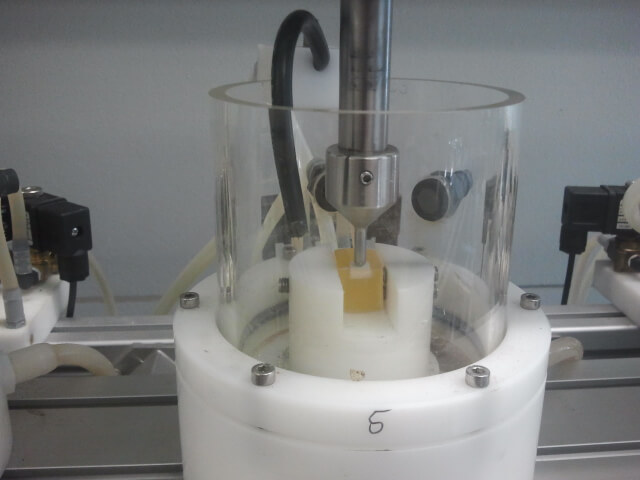
Plane test specimen clamped in a chewing simulator for artificial aging
Crown-shaped and flat test specimens were made from each of these materials and subjected to aging against human tooth enamel and stainless steel antagonists using thermomechanical loading in a chewing simulator (50 N, 5/55 °C, 600.000 chewing cycles). Half of the test specimens in each group were loaded with a sliding movement of 0,7 mm and the other half were axially loaded. The wear of the materials and the antagonists was evaluated using a Match 3D method and the topography of all surfaces was then examined using scanning electron microscopy (SEM).
Results of the study
When subjected to lateral loading, the PEEK material showed significantly lower material loss than the composite or the PMMA plastic. Within the axially loaded groups, this only applied to the flat test specimens tested with enamel antagonists. The test setup with crowns showed lower loss rates than the test setup with flat test pieces. Above all, the lateral movement led to significantly higher material losses than the axial load. On the antagonist side, no influence of the CAD/CAM material, the antagonist material, the application of force and the test specimen geometry could be determined.
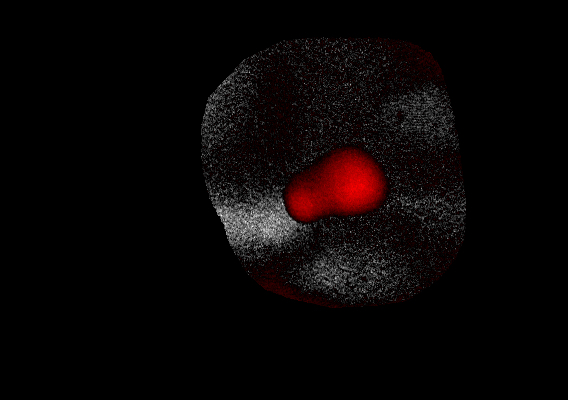
3D image of an abraded surface (crown) after chewing simulation
Conclusion
The wear of PEEK was generally lower than that of composite and PMMA-based materials under lateral loading. The test setup and the load on the test specimens played an important role. Planar test specimens loaded with lateral movement lead to higher material losses. The practitioner must take these aspects into account when evaluating the studies.
Study: Wimmer T, Huffmann AM, Eichberger M, Schmidlin PR, Stawarczyk B. Two-body wear rate of PEEK, CAD/CAM resin composite and PMMA: Effect of specimen geometries, antagonist materials and test set-up configuration. Dent Mater. 2016;32(6):e127-36.
Authors' summary
The abrasion behavior - material as well as antagonist - is particularly clinically relevant for the selection of the appropriate restorative material. Dentists and dental technicians should be sufficiently informed about this. To date, there are hardly any long-term clinical studies on CAD/CAM plastics or PEEK.