
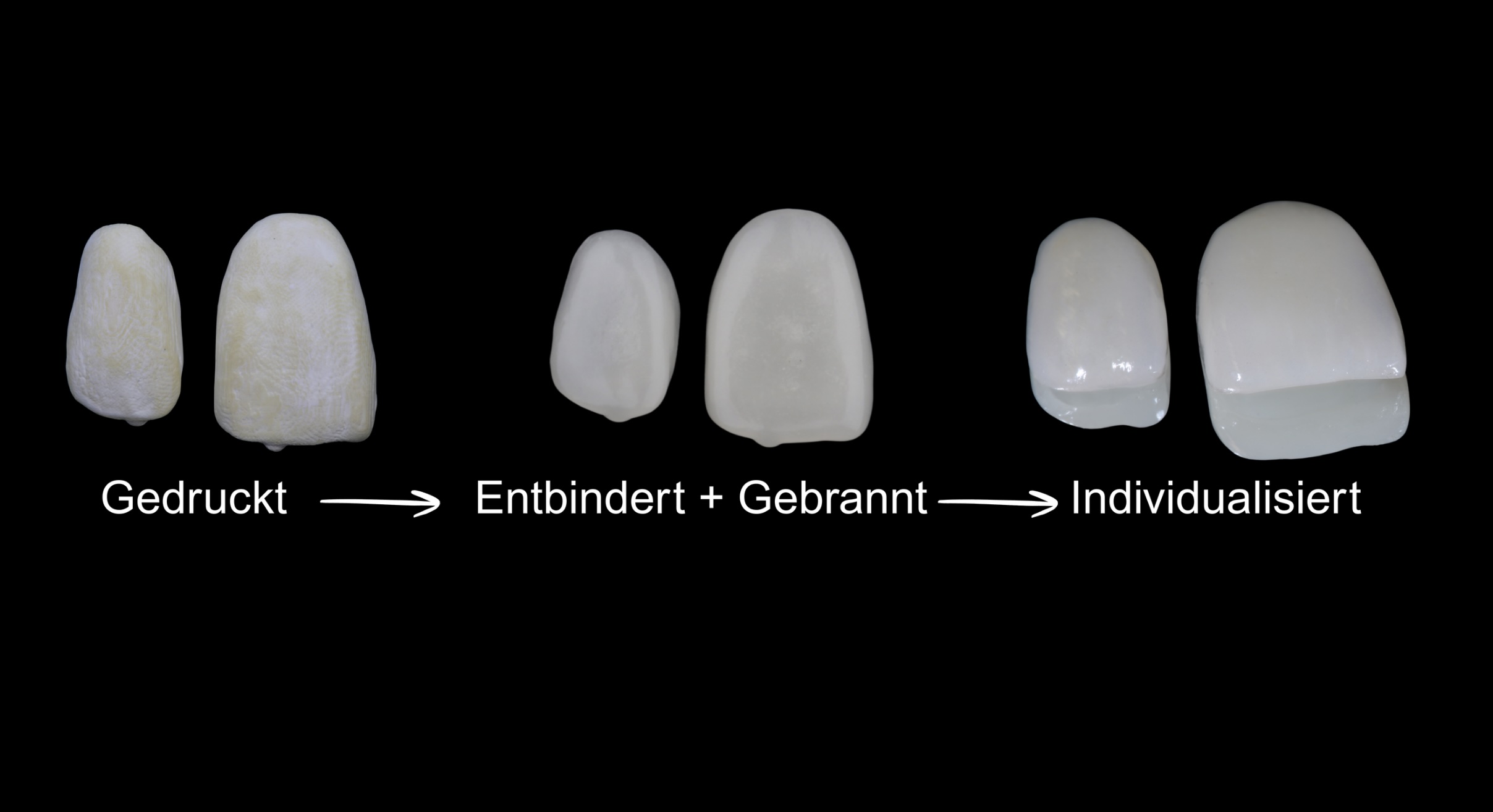
3D printing of ceramics? For a long time, this was considered almost impossible for dental restorations. Now, LSD printing is delivering promising results: In the future, silicate ceramics could be printed not only by milling or pressing, but also layer by layer.
Silicate ceramics have established themselves in dentistry thanks to their combination of aesthetics, biocompatibility, and durability. Currently, corresponding restorations are predominantly fabricated using subtractive processes. While 3D printing has long been commonplace in other areas of dentistry, no method has yet established itself for ceramic restorations. The main reasons are the limited material selection, often limited mechanical properties compared to subtractive references, and sometimes long processing times.
3D printing ceramics with LSD printing
Layer-by-layer slip deposition (LSD printing) is now emerging as a technology that appears suitable for overcoming these hurdles. This slip-based variant of binder jetting was specifically developed for ceramic materials. A water-based slip (feedstock) is applied layer by layer with a doctor blade, dried, and then locally solidified by a liquid polymer phase.
In this way, LSD printing opens up the possibility of not only producing ceramic restorations additively, but also of integrating them more efficiently and flexibly into everyday laboratory and practice routines in the future.
Critical process steps: feedstock, debinding and firing
In addition to the actual printing process, three factors are crucial for the quality of the final 3D-printed ceramic:
- feedstock development
- debinding and
- the burning.
The feedstock must have an optimized rheology to ensure uniform layers form and the workpieces remain free of defects. Blistering, inadequate particle distribution, or delamination can be significantly influenced by the formulation and preparation of the slurry.
Controlled debinding is necessary to completely remove organic components without cracking or internal stresses. Rapid debinding cycles, in particular, require precise coordination of binder content, particle size, and heating profile. The subsequent firing process serves not only to densify but also to selectively crystallize the silicate ceramic.
material and methods
In the presented study, test specimens in different orientations (XY, XZ, YZ) were produced using the LSD printing process and debindered and fired in a combined process. Sawn test specimens from CAD/CAM blocks (VITABLOCS Mark II) served as references. Shrinkage in the X, Y, and Z directions, the microstructure (density, crystal content, porosity, defects), and key mechanical properties such as biaxial flexural strength, fracture toughness, Martens hardness, and indentation modulus were analyzed. Single-tooth crowns and veneers were fabricated for demonstration purposes and examined for dimensional accuracy and esthetic appearance (Figure 1).
Results: shrinkage, microstructure and mechanical properties

Shrinkage: The study revealed a clearly direction-dependent shrinkage. After firing, it was significantly more pronounced in the Z direction than in the X and Y directions.

Microstructure: In terms of microstructure, the printed specimens produced a comparable image to the reference, albeit with a lower crystal content. Also noticeable were round pores and delaminations, which occurred primarily in the XZ and YZ orientations.

Elasticity: The flexural strength proved to be stable in the XY orientation and was close to the reference values. In Z-oriented samples, however, a reduction of up to 15% was observed.
Fracture toughness / hardness / indentation modulus: The reference sample also showed higher values for fracture toughness, hardness, and indentation modulus. This is attributed to the higher crystal content of the sawn CAD/CAM test specimens.
Conclusion
For everyday laboratory and practice use, this means: The LSD print is fundamentally capable of producing silicate ceramic restorations that meet minimum clinical requirements. In the tests, all test specimens met the standard values according to DIN EN ISO 6872:2019-01 for Class 1a restorations – i.e., monolithic single-tooth crowns in the anterior region, veneers, inlays, or onlays with adhesive cementation.
Of particular note is the newly developed combined process of debinding and firing, which reduces the total process time to just 45 minutes. This represents a clear advantage over traditional process chains.
At the same time, there is still room for optimization regarding the degree of crystallization and dimensional stability. Nevertheless, the study clearly shows that 3D printing of ceramics using LSD printing has the potential to establish itself as a future-oriented additive alternative to subtractive manufacturing.
examination
The results presented here are based on the following study: Hoffmann M, Schubert NH, Günster J, Stawarczyk B, Zocca A.
Additive manufacturing of glass-ceramic dental restorations by layerwise slurry deposition (LSD print). Journal of the European Ceramic Society 45 (2025) 117235