
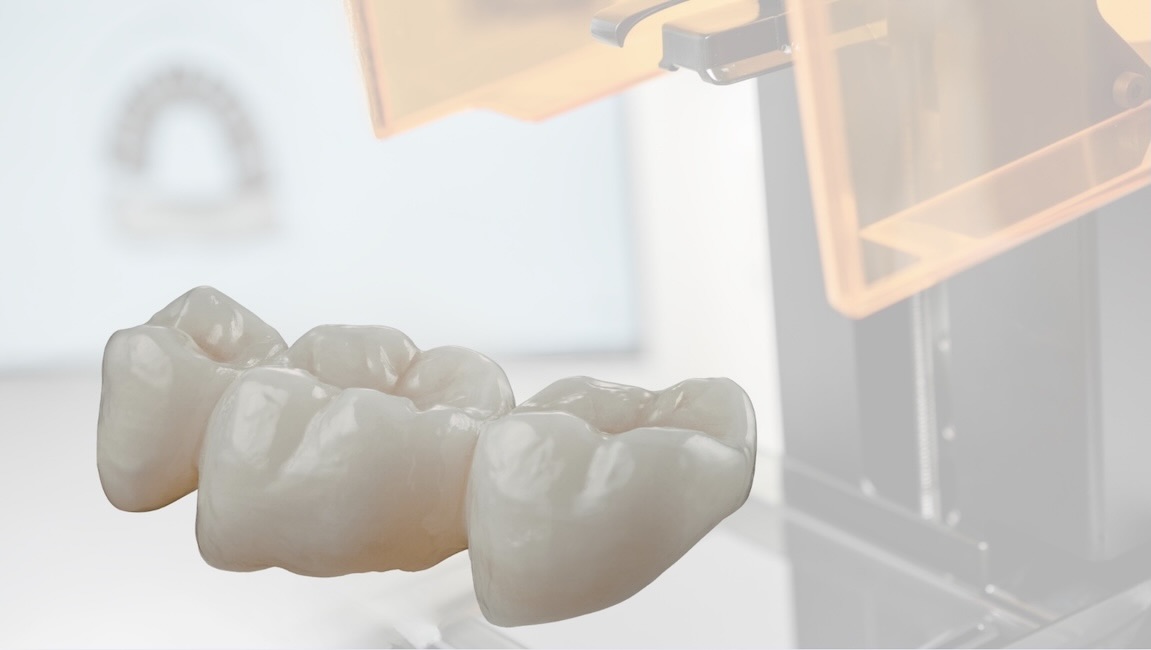
3D printing of fixed dental prostheses is gaining in importance. A key factor for the quality of polymer-based 3D printing materials is post-processing, particularly post-exposure. This study analyzes how different post-exposure protocols influence the conversion rate and mechanical properties such as Martens hardness, flexural strength, and Young's modulus of 3D-printed objects.
Modern dentistry relies more than ever on advances in digital technologies. In particular, the provision of fixed dental prostheses requires high-quality, state-of-the-art materials. 3D-printed dental prostheses are becoming increasingly established in a broader range of applications, as this technology offers not only a time-saving but also, in most cases, a cost-effective treatment option.
3D printing of fixed restorations
This study examines the material properties of three 3D printing resins for permanent and temporary use under different post-processing (PP) protocols. To meet the requirements for permanent use, these 3D printing resins contain fillers that can potentially impair post-processing through light scattering and absorption. Post-processing after printing is crucial for the durability, biocompatibility, and strength of the manufactured objects.
Various post-exposure devices, differing in light source, exposure time, and temperature, are available, but current research on this topic is still insufficient. In particular, the behavior of light sources within objects and the question of exposure depth have received little attention so far.
material and methods
As part of the investigation, 720 test specimens were produced from three resin groups (Fig.1): two resins for permanent use (VAR=Varseo Smile Crown plus , BEGO Medical; CRO= Crowntec, Saremco Dental) and one resin for temporary use (FRE=Freeprint temp, Detax).


To enable all measurements of DC and HM to be performed in different layers, these test specimens were printed in layer thicknesses of 2 and 4 mm and exposed only on the surface (Fig. 2). After cleaning in a centrifuge (Multifuge 1 SR; Heraeus, Hanau, Germany) for four minutes at 20 °C and 1500 rpm, all test specimens were re-exposed.
Two experimental post-exposure devices (NK Optik, Baierbrunn, Germany) were used to generate a total of 5 post-exposure protocols:
- P.P. 1: 385 nm LED; 76 mW/cm2, Time 180 s
- P.P. 2: 400 nm LED; 77 mW/cm2, Time 180 s
- P.P. 3: 460 nm LED; 49 mW/cm2, Time 180 s
- P.P. 4: xenon flash lamp; 37mW/cm2, Time 2000 flashes/200 ms
- P.P. 5: xenon flash lamp; 90mW/cm2, Time 2000 flashes/200 ms
Following the preparation of the test specimens, initial measurements of all parameters were performed. DC was determined using a Raman spectrometer (inVia Qontor; Renishaw, Pliezhausen, Germany) at wavelengths of 1610 cm⁻¹ and 1640 cm⁻¹ . To determine the initial HM values, a universal testing machine (ZHU 0.2; ZwickRoell, Ulm, Germany) was used, which applied the tip of a Vickers diamond to the surface of the test specimens with a maximum test force of 9,81 N. FS was determined using a universal testing machine (Zwick 1445; ZwickRoell) by applying a vertical force at a feed rate of 1 mm/min. The EM values could then be calculated from the corresponding FS values.
Following these initial measurements, the test specimens for the DC and HM values were artificially aged (thermocycler THE-1100; SD Mechatronik, Feldkirchen-Westerham, Germany) at water temperatures of 5 °C and 55 °C with a dwell time of 30 seconds each for a total of 10.000 cycles, to simulate 12 months of use of the dental prosthesis in the oral cavity (Fig. 3). The aged test specimens were then measured for DC and HM. To determine the FS and EM values after aging, these test specimens were aged in the thermocycler immediately after printing and subsequently measured in the same way.
The collected data were statistically evaluated using IBM SPSS Statistics v29.0 with Kolmogorov-Smirnov, Kruskal-Wallis, Mann-Whitney U and Wilcoxon tests as well as Spearman's correlation (p<0.05).

Results
After post-exposure with stroboscopic xenon light (PP 4 and PP 5), all three materials tested showed the highest values for DC and HM (Fig. 4). The measured data also demonstrated a pronounced depth dependence of the polymerization, as both DC and HM decreased continuously with increasing specimen depth (0 mm > 2 mm > 4 mm). This suggests that a homogeneous light distribution is essential, as sufficient curing occurs primarily on the light-facing surface. Furthermore, the FS and EM values for all three resins after exposure with PP 4 and PP 5 were significantly higher than those of the LED groups (PP1-3). The short-duration, high-intensity light pulses of the xenon stroboscopic light generate a broad emission spectrum with simultaneously high radiation intensity, which has a beneficial effect on the mechanical material properties of the resins.
Artificial aging led to an increase in DC and HM within the LED groups, which is presumably due to progressive polymerization caused by the increased water temperature.

Conclusion
The aim of this study on 3D printing was to analyze the influence of different post-exposure protocols and artificial aging on the conversion rate, Martens hardness, flexural strength and the modulus of elasticity of various resins for fixed dental prostheses.
The results show that the choice of post-curing protocol should be indication- and material-specific. Post-curing using xenon stroboscopic light proved particularly suitable, although homogeneous light distribution is crucial here as well. This is especially true for voluminous restorations, where sufficient curing in deeper material layers must be ensured. For dental practices and laboratories, the results underscore that post-processing is not a standardized, secondary step, but rather contributes significantly to the mechanical stability and long-term clinical suitability of 3D-printed dental prostheses.
examination
The results presented here are based on the following study: Gekle S, Mayinger F, Kreitmair U, Reymus M, Hoffmann M, Stawarczyk B. Impact of different post-polymerization protocols on the material properties of three printed dental resins. J Mech Behav Biomed Mater 2025;172:107164.